Beekeeping Cottage Food Laws: Selling Honey From Home
Honey often is not a cottage food at all. Which rulebook applies, the three offices to call, and the records a permit application will ask you for.
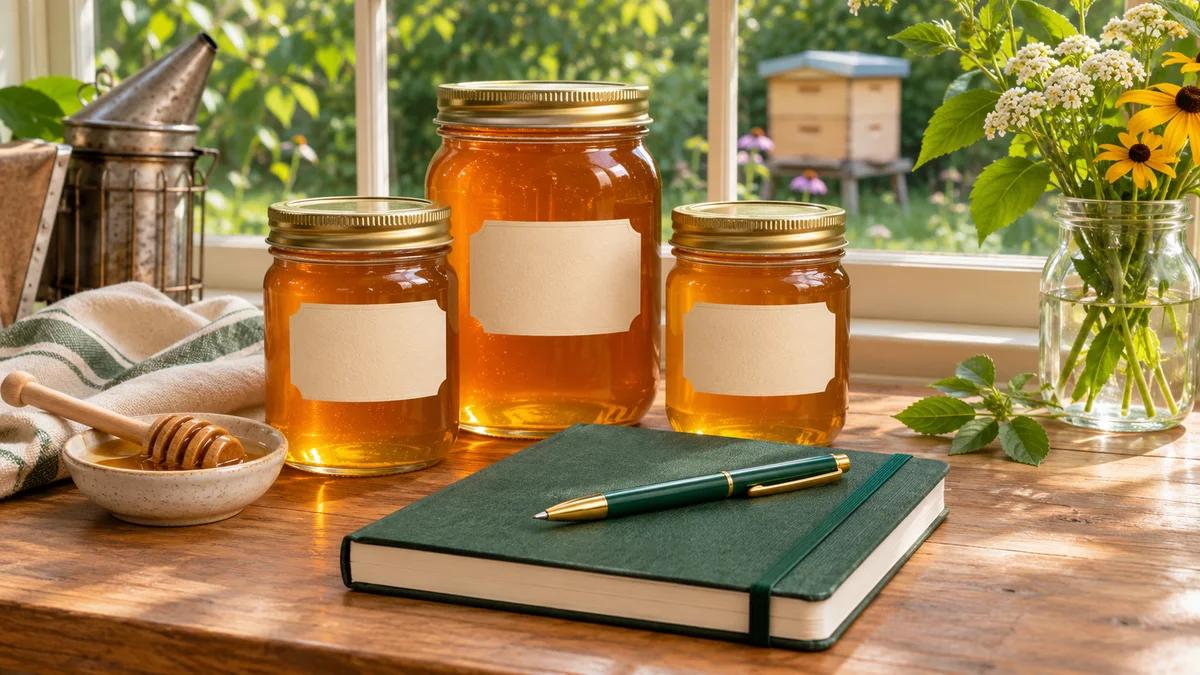
Honey often is not a cottage food at all
Selling a few jars of honey off the porch feels like it should be simple. It mostly is — honey is one of the easier foods to sell legally from home in much of the US. But "mostly simple" still means knowing which rulebook applies to you, and that is where people get stuck, because most cottage food guides are written for jam and baked goods, not honey.
This is not legal advice. We are an engineering team that builds the app beekeepers use to run their records, not a law firm, and the honest answer to almost every specific question below is "confirm with your own state department of agriculture or health." What we can do is lay out the pattern clearly enough that you know which office to call, and what records to have ready when you do.
The rule most guides skip
Cottage food laws were written for jam, baked goods and other home-kitchen products. Honey is often treated differently, under a separate set of beekeeping or agricultural statutes — not because it is unregulated, but because many states consider raw honey a low-risk, non-perishable agricultural product with rules of its own.
Three real examples of how that plays out, checked against the current statutes and county guidance in November 2026. These change, so confirm your own state before you sell:
| Where | Honey under the cottage food law? | Permit to sell direct? | Sales cap |
|---|---|---|---|
| Florida | Yes — s. 500.80, the "Home Sweet Home Act" | No state food permit; the department may inspect only after a complaint | $250,000/yr gross, all cottage foods combined, no wholesale |
| New Jersey | No — raw, unprocessed honey was written out of the definition in Dec 2022 | No Dept. of Health cottage food permit; the Dept. of Agriculture still regulates unprocessed honey | None set by the cottage food law |
| San Bernardino County, CA | Yes — under California's CFO tiers | Yes — a county CFO permit, plus apiary registration with the county agricultural commissioner | Class A $75,000/yr (direct sales) or Class B $150,000/yr (direct plus wholesale) |
Three jurisdictions, three different answers, all legitimate. That is the actual shape of this problem: there is no single "beekeeping cottage food law." There is your state's cottage food statute, your state's agriculture or apiary statute, and sometimes your county's health department rules — and you need to check all three, not just the one that shows up first in a search.
Note what the Florida and New Jersey rows have in common. Neither one means "nobody regulates this." Florida's exemption comes with a dollar ceiling, a no-wholesale condition, and a label that has to carry the beekeeper's full street address (a P.O. box does not count) and the sentence "Made in a cottage food operation that is not subject to Florida's food safety regulations"; New Jersey's exemption moved raw honey from one department's rulebook to another's. "Exempt from cottage food law" is the start of the answer, not the end of it.
Where to actually look, in order
Keep the Records a Permit Application Asks For
Harvest date, source hive and treatment history on one record, logged at the hive with no signal. Free for up to 5 hives and 5 apiaries, no card required.


- Your state department of agriculture, or the state apiarist's office. Many states register beekeepers and apiary locations separately from any food-sales permitting, and that office can tell you definitively whether honey falls under your state's cottage food law or a separate honey statute.
- Your state's cottage food statute. Read it specifically for whether honey is named, exempted or simply silent — and if it is exempted, ask which office picked it up instead.
- Your county or city health department. Some jurisdictions layer a local permit on top of state rules, particularly for farmers' market sales or wholesale to a store. California is the clearest example: the permit is issued county by county, not by the state.
If you are scaling past hobby sales, our beekeeping business page and the income breakdown cover the revenue side of this decision — how many hives and which sales channels actually make a side business work, once you have confirmed you can legally run one.
What a regulator actually wants to see
Whichever office ends up governing your sales, the questions they ask tend to rhyme. Which hives did this honey come from? When was it harvested? Was anything applied to those hives before harvest, and was the pre-harvest interval respected? Can you point at a consistent batch or lot identifier if a jar is ever questioned?
That is a records problem before it is a legal one, and it is the part most cottage food guides never mention, because they are written for people who do not keep per-hive records at all.
Here is what that paper trail looks like if you are already running your apiary through HiveSense:
- Harvest date and source hive, logged at the time of harvest. Every pull gets a date and a hive it belongs to — not a figure reconstructed from memory three weeks later when a permit application asks for it.
- Treatment-to-harvest timing, on the same record. If you treated for varroa before this harvest, our pre-harvest interval guide covers how long to wait before that honey is sellable. Because treatments are logged against the same hive as the harvest, the gap between them is a lookup rather than a cross-reference between a paper notebook and a calendar.
- Per-hive batching, without extra work. If a regulator or a customer asks which hives a batch came from, the answer is already in your records.
- All of it offline, at the hive. You can log the harvest standing in the yard with gloves on and no signal. The record exists the moment you make it, not whenever you get back to a kitchen table with a notebook.
- Something you can hand over. On any paid plan, inspections, treatments and harvests export as CSV or PDF, organised by apiary and hive — the version an inspector or a wholesale buyer asks for.
None of this replaces checking your state's actual rules. It means that by the time you have confirmed what is required, you are very likely already keeping the records that satisfy it — because you were keeping them for your own sake, not for a permit application.
The honest bottom line
Most hobbyists selling a modest amount of honey directly to neighbours, at a farm stand or at a local market will find the bar lower than they feared. Honey is genuinely one of the friendlier cottage-adjacent products to sell legally. The work is confirming which set of rules applies to you specifically, not clearing some uniformly high bar.
If you are seriously weighing turning hives into income rather than just covering your own costs, our beekeeping startup cost guide walks through what it costs to get there, and how much beekeepers actually make covers the revenue side — the deeper version of exactly this question.
Call the state apiarist's office before you call anyone else. They answer this question daily, they know their state's current rules — which change more often than blog posts get updated — and unlike most of the internet, they are not guessing.
Sources
Outside figures checked 2026-11-05 against the statutes and county guidance below. Product behaviour described above matches the shipped free and paid tiers.
- Florida Statutes s. 500.80, cottage food operations — exemption from s. 500.12 permitting, $250,000 annual gross sales limit, inspection only upon receipt of a complaint, no wholesale
- UF/IFAS: Selling Honey Under Florida's Home Sweet Home Act — no FDACS food permit, inspection only on a complaint, the $250,000 combined cap, and the label wording and street-address requirement
- New Jersey A3991 (P.L.2022, c.124) — raw, unprocessed, un-infused, unpasteurised honey is not a cottage food product; signed 1 December 2022
- San Bernardino County EHS: Honey Handbook for Cottage Food Operations — CFO permit required from Environmental Health Services to sell honey to the public, apiary registration with the County Agriculture Commissioner required under s. 29043 of the California Food and Agriculture Code, Class A $75,000/yr and Class B $150,000/yr caps
Frequently asked questions
- Do I need a permit to sell honey from home?
- It depends entirely on your state, and sometimes on your county. Florida exempts cottage food operations, honey included, from state food permitting under section 500.80 as long as annual gross cottage food sales stay at or below $250,000 and sales are not wholesale. New Jersey removed raw, unprocessed honey from its cottage food definition in December 2022, so no Department of Health cottage food permit applies, though the Department of Agriculture still regulates unprocessed honey. San Bernardino County, California, by contrast, requires a county Cottage Food Operation permit before you sell honey to the public, plus apiary registration with the county agricultural commissioner. Confirm your own case with your state department of agriculture or state apiarist before you sell.
- Is honey a cottage food?
- Often not. Cottage food statutes were written for jam, baked goods and other home-kitchen products, and several states handle raw honey under separate beekeeping or agricultural rules instead. New Jersey wrote raw, unprocessed honey out of its cottage food definition outright in 2022. Being exempt from a cottage food law almost never means honey is unregulated, though: it usually means honey is regulated somewhere else, by a different office.
- What records should I keep if I sell honey?
- Whichever office governs your sales, the questions tend to rhyme: which hives this honey came from, when it was harvested, whether anything was applied to those hives before harvest and whether the pre-harvest interval was respected, and whether you can point at a consistent batch or lot identifier. That is a records problem before it is a legal one. Logging the harvest date against the source hive at the time of harvest, with treatments on the same hive record, answers all four without reconstructing anything from memory.
The business side, in one printable PDF.
Break-even math at 10, 25 and 50 hives, the questions to ask your state before the first market, label rules, and a 90-day launch plan. One email, then it lands in your inbox.
Use HiveSense for this
Commercial Beekeeping Software — Multi-Apiary & Team Seats
Multi-apiary tracking, team seats with role-based access, and CSV/PDF exports by apiary. Tell us about your operation and a real human replies within 24 hours.
Offline Beekeeping App — Works Without Internet
Log inspections, voice notes, and BLE sensor data with zero cell signal. Every feature works at the hive.
More from the blog
View allBeekeeping for Profit: Signs You've Outgrown the Hobby
The symptoms that say a beekeeping operation has outgrown memory and a notebook, what the published hive-count bands actually say, and what has to change first.
Beekeeping Income Beyond Honey: 10 Ways Hives Pay
Honey is the most seasonal thing a hive produces. Ten verified ways to earn from your hives year-round — nucs, queens, pollination, managed hives, wax, and more — with real 2025–26 prices.