Queen Tracking: Monitor Queen Performance by Season
The beekeeper guide to queen tracking — marking queens, scoring performance, spotting failing queens early, and building a record system that lets you breed from your best colonies.
Why Queen Tracking Is the Foundation of Everything Else
A productive queen lays roughly 1,500 to 2,000 eggs per day at peak — more than her own body weight, every day, for months. She is the only bee in the colony whose genetics matter for breeding decisions. Her pheromones hold the colony together. When she fails, the colony fails with her.
Most hobbyist beekeepers lose track of their queens within the first season. They think they'll remember which hive got the new queen, which colony superseded, which one swarmed in May. By September they're looking at a spotty brood frame and wondering whether the queen they see is the original or a daughter that emerged six weeks ago from a cell they didn't notice.
The fix is systematic: mark every queen, track every replacement, score every colony against a consistent rubric, and keep the records in a place that won't disappear. This post walks through how.
The International Queen Color Code
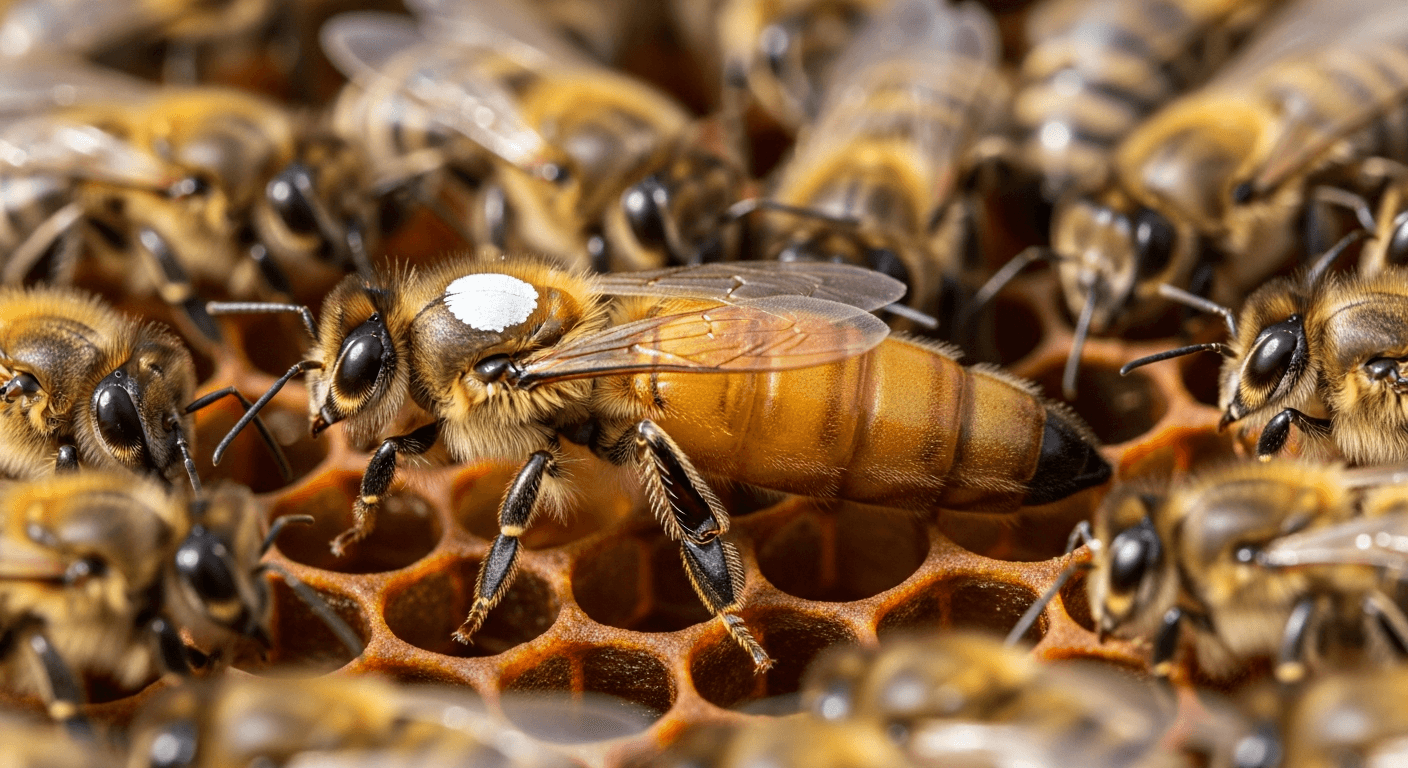
Queen marking has been standardized globally so beekeepers in any country can read a queen's age at a glance. The code is a 5-color rotation keyed to the last digit of the year she hatched:
| Year ends in | Color | Years |
|---|---|---|
| 1 or 6 | White | 2021, 2026, 2031 |
| 2 or 7 | Yellow | 2022, 2027, 2032 |
| 3 or 8 | Red | 2023, 2028, 2033 |
| 4 or 9 | Green | 2024, 2029, 2034 |
| 5 or 0 | Blue | 2025, 2030, 2035 |
The mnemonic most people use is "Will You Raise Good Bees?" White, Yellow, Red, Green, Blue. Queens in 2026 are marked white.
A five-color rotation works because queens functionally never stay productive past three years in managed colonies. There's no realistic way to confuse a 2026 white queen with a 2021 white queen because the 2021 queen will be dead or superseded.
Marking her, of course, assumes you can get hold of her in the first place. If that is the sticking point, how to find the queen bee in a hive covers where she actually sits in the nest and the scanning method that finds her without a forty-minute teardown.
Why Mark Queens
Four reasons, in order of practical value:
- Age tracking. You know when she was installed and when to plan replacement. No guessing.
- Supersedure detection. Walk into a colony expecting a marked queen, find an unmarked one — you know the colony replaced her. That's a data point about her genetics (frequent supersedure often means poor mating or inferior stock).
- Queen-finding speed. A colored dot on the thorax is visible across 3-4 inches of comb even when workers are swarming over her. First-year beekeepers routinely spend 20+ minutes hunting for an unmarked queen; a marked one is a 3-minute job.
- Breeding traceability. If you're grafting or raising your own queens, marking lets you trace daughter queens back to mother queens and attribute performance to specific bloodlines.
How to Mark Safely
The industry-standard marking pen is the Uni Posca PC-5M water-based paint marker. Every major bee supplier sells it, usually in pre-packaged 5-color sets labeled as "queen marking pens." The paint is water-based, non-toxic, and dries in 30-60 seconds.
The safest capture method for new beekeepers is a plunger-style queen marking tube — a clear plastic cylinder with a soft foam plunger. Gently push the plunger until the queen is held against the mesh end with her thorax facing up. No direct contact, no risk of squeezing her.
The marking sequence:
- Shake the Posca pen, then depress the tip on scrap paper until paint flows. Blot the tip so a bead doesn't drown the queen.
- Apply a dot the size of a match head in the center of the thorax. Not the head. Not the abdomen. Not the wings.
- Wait 30-60 seconds for the paint to set.
- Release her back onto a brood frame (same frame she came from if you can remember it).
Before you mark your first queen, practice on drones. Same thorax, same color sheet, no cost if you fumble. Most beekeepers figure out the motion in 5-10 drones.
Mortality risk from marking is low but real. The failure modes are: squeezing the queen in a too-tight clip, getting ink on her wings or spiracles, or applying enough paint that workers groom her aggressively and reject her. Conservative estimates from practitioner literature put rejection and supersedure after marking at a few percent when technique is reasonable.
How Long Queens Actually Last
There's a critical distinction between biological lifespan and productive lifespan. Queens can live 5-7 years in rare cases; Penn State Extension cites up to 7. In managed colonies, the typical range is 1-3 years with a noticeable productivity decline after year one.
Commercial beekeepers have moved toward annual — or even twice-a-year — requeening. The reason is a quiet quality crisis in modern queen production. A 2016 PLOS ONE study by Pettis and colleagues (Colony Failure Linked to Low Sperm Viability in Honey Bee Queens) compared queens from healthy and failing colonies:
- Healthy colony queens: 85-92% sperm viability
- "Routine replacement" queens from commercial breeders: 57%
- East Coast failing queens: 54%
- West Coast failing queens: 55%
Temperature exposure during shipping was a major culprit. Just 1-2 hours below 8°C or above 40°C was enough to measurably reduce sperm viability. Deformed Wing Virus-B and Nosema load were also elevated in failing queens.
The practical consequence: "queen failure" is consistently the #1 cause of colony mortality in Bee Informed Partnership annual surveys. If your queen is more than a year old and something looks off, replace her. The era of riding a queen for three seasons is gone.
What a Failing Queen Looks Like
Six signs, ordered from worst to earliest:
- Drone-laying queen. Drone-sized bullet-capped cells interspersed through the worker brood area. Her spermatheca is depleted or was never properly filled. She's done.
- Shotgun brood pattern. Scattered empty cells throughout capped brood. Can mean hygienic removal of diseased brood, a failing queen laying unfertilized eggs that workers remove, or inbreeding depression (diploid drones). Context disambiguates.
- Reduced laying rate. Less than ~500 eggs per day during the active season. A peak queen hits 1,500-2,000 eggs/day.
- Multiple supersedure cells on the face of the comb. The colony has already diagnosed her and is building her replacement. Don't argue with the workers — they're usually right.
- Emergency queen cells on worker brood. She has disappeared or is about to be replaced.
- Small, lethargic, ragged-looking queen. Subjective but worth noting, especially compared to her condition six months earlier.
Track Every Queen in HiveSense
Lineage, laying rate, and supersedure alerts — all offline.
How Supersedure Actually Works
Worth understanding because you'll see it happen repeatedly and the records you keep will make more sense.
As a queen ages, her production of queen mandibular pheromone (QMP) declines. Workers constantly monitor pheromone signals. When the signal weakens, the colony swings into replacement without consultation. They select 1-3 young worker larvae (less than 24 hours old), feed them royal jelly exclusively, and cap them as supersedure cells on the face of the comb.
A virgin queen emerges ~16 days after the egg was laid, matures for 5-8 days, takes 1-3 mating flights over several days, returns, and begins laying 2-3 days after her last flight. For a period — sometimes weeks — the old mother and the new daughter both lay in the same colony. Unlike swarming, where the mother leaves, supersedure keeps the colony intact and the daughter eventually kills or replaces the mother.
The record-keeping implication: if you marked your queen and suddenly find an unmarked one, the supersedure date is the gap between the last time you saw her marked and the first time you saw her daughter. That's a data point about the colony's genetics. If you see multiple supersedures in the same colony across seasons, the line is unreliable — don't propagate from it.
Scoring Queens: What to Actually Measure
Serious breeders score across multiple dimensions, not a single "good/bad" flag. The 2023 COLOSS BEEBOOK (Standard methods for rearing and selection of Apis mellifera queens 2.0) in the Journal of Apicultural Research codifies a rubric along these lines:
| Trait | 1 (Cull) | 3 (Average) | 5 (Breeder Candidate) |
|---|---|---|---|
| Brood pattern | Shotgun, <50% solid | 70-80% solid | >90% solid |
| Temperament | Stings without provocation | Some runniness | Sits on frame, no stings |
| Spring buildup | Weak through April | Normal buildup | Ahead of apiary average |
| Honey yield | Below apiary average | Average | Top 20% of apiary |
| Mite load (alcohol wash) | >6 per 100 bees | 2-3 per 100 | <2 per 100 |
| Winter survival | Dead or collapsed | Survived, weak | Survived strong |
| Swarm tendency | Swarmed despite management | One cell cycle | No swarm cells |
The discipline is that you grade every colony on every trait at every inspection, not just when something seems wrong. You cannot identify a breeder candidate in retrospect if you only recorded problems.
A single lousy temperament rating can also mean the bees had a bad day — skunk harassment the night before, an approaching storm, a queenless neighbor. Average across multiple inspections before drawing a conclusion.
Hygienic Behavior: The Freeze-Killed Brood Assay
For beekeepers who want to go beyond subjective scoring, there's one quantitative test that predicts disease resistance better than any other: the freeze-killed brood assay, developed by Dr. Marla Spivak at the University of Minnesota. Spivak's work established the 95% removal in 24 hours, confirmed by two separate tests threshold for classifying a colony as hygienic.
The short version:
- Queen must have been laying at least 7 weeks. No recently introduced brood.
- Find a frame with extensive capped brood (pink to light-purple-eyed pupae stage).
- Press a 2-inch pastry ring into the brood, seal with honey, pour 35ml liquid nitrogen, let evaporate, pour another 40ml, let fully evaporate.
- Return at exactly 24 hours.
- Count remaining cells. Formula: (Total cells − remaining) ÷ total × 100 = hygienic response %.
- ≥95% = hygienic. Repeat on a second frame cycle to confirm.
Colonies that score hygienic on two tests are breeder candidates for Varroa resistance, chalkbrood resistance, and American Foulbrood resistance — hygienic bees remove diseased brood before pathogens spread.
For hobbyists without liquid nitrogen, a simpler version uses a frozen comb insert from the freezer. The thresholds are slightly different but the principle is the same: mark the cells, freeze them, return 24 hours later, count what's been cleared out.
The Major Varroa-Resistance Lines
If you're shopping for queens with proven genetics, these are the programs that have produced measurable mite-resistance results:
- VSH (Varroa Sensitive Hygiene). Developed at USDA-ARS Baton Rouge by John Harbo and Jeffery Harris starting in 1992. VSH bees remove around 91% of pupae with reproductive mites. Harbo & Harris published the foundational paper in Apidologie (31: 689-699, 2000).
- Minnesota Hygienic. Dr. Marla Spivak's program at the University of Minnesota, built on the freeze-killed brood assay.
- Pol-line. Developed by USDA-ARS in 2014 by outcrossing VSH queens to US commercial stock. A 2022 USDA-ARS result: Pol-line colonies showed 62.5% winter survival with no fall Varroa treatment, compared to 3% for standard commercial stock under the same no-treatment conditions.
- Purdue Mite-Biters. Developed by Krispn Given and Greg Hunt at Purdue, selected for grooming behavior where workers physically damage Varroa mites. Purdue stock ran roughly one-third the mite levels of commercial stock in their 2014 evaluation.
- Russian bees. Developed by USDA-ARS from Primorsky-region Russian stock that has coexisted with Varroa for over 100 years.
- Saskatraz. Canadian breeding line from Saskatchewan, selected for overwintering survivorship and low mite population growth.
None of these lines are magic bullets — open-mated daughters lose the trait quickly because they mate with local drones — but they're a better starting point than generic commercial stock if you're trying to reduce treatment pressure.
Requeening: When and How
Best windows: Spring (April-June) is the strongest time. Plenty of nurse bees, weather is warming, and the new queen has the full season to prove herself. Late summer (August-early September) is second-best — a fresh queen going into winter lays 24-25% more brood in November-January than an old queen, which directly improves spring buildup.
Acceptance rate by method:
- Slow release with candy plug: 90-100% acceptance. The queen ships in a small cage with a cork and a candy compartment. Remove the cork to expose the candy, place the cage candy-side up between brood frames, walk away. Workers eat through the candy over 2-5 days while absorbing her pheromones.
- Direct release into a confirmed queenless, broodless colony: High success if the colony has been queenless at least 24 hours. Direct release into a colony you haven't verified fails roughly 30% of the time.
- Push-in cage on drawn comb: Highest acceptance rate for difficult colonies but more labor.
Why introductions fail:
- The colony wasn't actually queenless (the old one was hiding).
- Laying workers had already established (happens after 3+ weeks without open brood).
- Weather went cold and the colony got defensive.
- You crossed races the colony doesn't recognize pheromonally (Italian into Carniolan or vice versa — Randy Oliver has written about this).
- The queen was already compromised on arrival from shipping stress.
Sourcing Queens
Prices in 2024-2025 for the North American market:
- Mated queens from commercial breeders: $35-$55 each
- Volume pricing (20+ queens): $32-$37
- Instrumentally inseminated (II) breeder queens: $150-$500+
- Shipping (USPS Express, often required): $25-$35
- Carniolan premium over Italian: ~$5-10
- Varroa-resistant lines (VSH, Pol-line, Purdue, Saskatraz): +$5-15
A 2023 Alberta study found domestic queens had 25% better winter survival than imported queens. Pettis et al.'s shipping-damage findings explain why: transit stress kills sperm even when the queen herself arrives alive. Buying local isn't just an ideology — it's a measurable quality difference when the breeder is selecting for local conditions (not just reselling California stock under a local label).
Sue Cobey's New World Carniolan line is the longest-running closed-population breeding program in North America (established 1982, now around 39 generations in). The Page-Laidlaw closed population breeding methodology she uses — developed by Robert Page Jr. and Harry Laidlaw Jr. at UC Davis — is the foundation of most modern North American queen breeding lines.
What Your Records Should Actually Contain
For every queen in your operation, at minimum:
- Queen ID (hive number + color + year)
- Mother queen ID (if known)
- Install date and method (graft, II, purchased, swarm capture, supersedure daughter)
- Source (breeder name, your own graft, natural supersedure)
- Brood pattern score at every inspection
- Temperament score at every inspection
- Frames of bees, capped brood, honey, pollen (a Liebefeld-style colony strength count)
- Varroa count results with dates
- Disease observations
- Honey yield at extraction
- Overwintering outcome
- Supersedure or swarming events with dates
- Daughter queen performance (fed back to mother's score if you're breeding)
A serious breeder is measuring three-generation performance: grandmother queens, daughter queens, and granddaughter queens. That only works if the records survive long enough to connect them — which is the quiet reason most hobbyist breeding programs die. You need the records more than the technique.
The HiveSense Angle
HiveSense tracks every queen by hive, records mother-daughter relationships automatically when you log a supersedure or a graft, scores inspections against a consistent rubric, and keeps everything on your phone so the records are there when you actually need them — in the apiary, hands full, no cell signal. If the queen you marked as "2026 White" doesn't turn up on your next inspection, the app flags the supersedure and starts tracking her replacement from the first sighting.
Breeding from your best colonies isn't hard in concept. It's hard because the records fall apart. We built the record layer so you can focus on the bees.
Track Every Queen in HiveSense
Lineage, laying rate, and supersedure alerts — all offline.
Free to start. Works offline. No credit card required.
Use HiveSense for this
More from the blog
View allHow to Find the Queen Bee in a Hive (Without a Teardown)
Where the queen actually sits in the nest, what separates her from a worker at a glance, the six-step search that works, and what to do when you cannot find her.
How to Detect a Queenless Hive: 9 Signs to Check
How to detect a queenless hive — no eggs, laying workers, queenless roar, and the frame-of-brood test. With a decision tree for what to do once you confirm it.