Your First Spring Hive Inspection: The Complete Checklist
When to do your first spring inspection, what to look for, how to assess population and food stores, and the common spring problems and how to fix them.
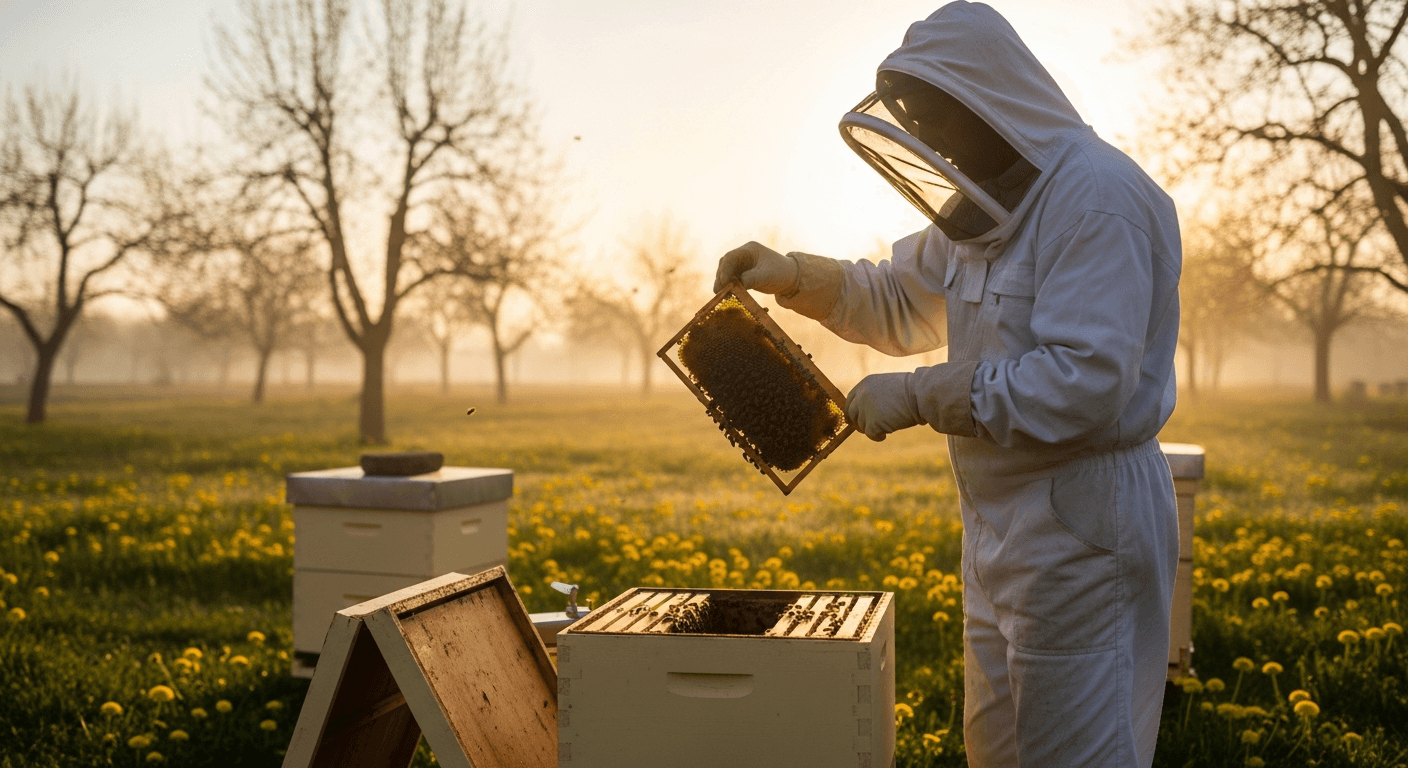
The First Inspection Sets the Whole Season
There is no more consequential moment in the beekeeping year than the first spring inspection. What you find — or fail to find — determines whether the colony reaches its linear growth phase with a laying queen, adequate food, and a mite load low enough to survive the summer. Miss a failing queen in March and you're watching a colony collapse in June while drones are gone and replacement queens are impossible to find locally.
The goal of this post is a specific, actionable protocol: when to open the hive, what to check in what order, how to diagnose the common problems, and what to do about them. No hand-waving. No "check on your bees every now and then."
Timing: When to Actually Open the Hive
The single most dangerous mistake is going in too early. Honey bee brood is stenothermic — eggs, larvae, and pupae develop properly only in a narrow range of 91-96°F (33-36°C). Capped pupae, especially emerging bees, are the most temperature-sensitive. Chilling capped brood kills emerging workers or produces misoriented adults with reduced longevity even if they survive. A 10-minute inspection on a too-cold day can set the colony back weeks.
The temperature thresholds experienced beekeepers use:
- Quick lid pop (external assessment, no frame manipulation): 50°F / 10°C on a sunny, calm day.
- Full frame-by-frame inspection: 60°F / 15.5°C or warmer, with consistent nights staying above freezing and lows in the upper 40s-50s for several days prior.
- The real rule: If you hesitate because the wind cuts through your jacket, the bees feel it worse. Wind matters as much as the thermometer.
Weather window requirements:
- Midday to mid-afternoon (late morning to 3 PM ideal)
- Sunny or lightly overcast
- Winds under 10 mph
- Bees already flying on their own at the entrance
- Inspection duration no more than 10-15 minutes on marginal days
Regional timing guidelines
| Region | Typical first full inspection |
|---|---|
| South Florida, South Texas | Late January - early February |
| Georgia, Gulf Coast | February - early March |
| California Central Valley | February (during almond bloom) |
| Mid-Atlantic, Ohio Valley | Mid-to-late March |
| Pacific Northwest | Late March (lid pop), April (full inspection) |
| Northeast, Upper Midwest, New England | Late March - April |
| UK (south) | "When the apple is in bloom" — late April |
| UK (Scotland/North) | Mid-April |
| Germany, Central Europe | Late March - early April (willow/hazel pollen) |
| Scandinavia | May |
The old UK rule — "do not open the brood box until the apple is in bloom" — exists for good reason in temperate climates. Use the calendar as a guide, the thermometer as a gate, and phenology (what's blooming) as the confirmation.
Pre-Inspection: What the Entrance Tells You
A disciplined beekeeper reads the entrance before lifting the lid. Ten minutes of observation on a warm afternoon tells you most of what you need to know:
- Flight intensity: Steady directional foraging traffic = healthy colony. Aimless hovering = queenless.
- Cleansing flights: Small yellow-brown spots on the hive front or nearby snow are normal and healthy — bees hold waste all winter and release it on the first warm day. This is not dysentery.
- Pollen loads coming in: The strongest single indicator that the queen is laying. Multiple pollen colors (yellow from willow/maple, orange from crocus, pale from alder) confirm foraging on diverse sources. Pollen is brood food — if they're bringing it in, there's brood.
- Dead bee count at the entrance: A scattering is normal winter attrition. A mound of several cups' worth warrants concern. Undertaker bees should be actively carrying dead bees out on warm days.
- Hefting: Tilt the hive slightly from the back. Compare the feel against the same hive in previous seasons. "Moderately heavy in January, alarmingly light in February" = starvation risk. Peak starvation risk is actually late winter/early spring, not midwinter — an expanding colony burns stores faster than a clustered one.
- Gentle tap-and-listen: A quick tap on the side should produce a brief rising buzz that settles quickly. A dead or dying colony produces little response.
- Orientation flights: Young bees doing loops at the entrance on warm days tell you brood has been emerging for 2-3 weeks.
The Inspection: What to Look For, in Order
1. Eggs, first and foremost
Eggs are the strongest queen-right indicator because they're only visible for 3 days after laying. See eggs, and you know there was a laying queen within the last 72 hours. You don't need to find her.
Hold the frame with the sun over your shoulder, tilt to catch light into the cell, and look for rice-grain-shaped eggs standing vertically at the bottom center of the cell.
What to distinguish:
- Queen-laid: One egg per cell, centered at the bottom, glued upright.
- Laying workers: Multiple eggs per cell, attached to side walls, scattered distribution.
- Drone-laying queen: Single eggs in a pattern, but in worker-sized cells with domed "bullet" drone cappings.
2. Brood in all stages (BIAS)
Eggs + open larvae + capped brood = the queen has been laying consistently for at least 12 days. This is the gold-standard confirmation of colony health. A missing stage tells you when something went wrong.
3. Brood pattern quality
A healthy queen lays in solid concentric rings outward from a warm center. Solid pattern means >90% cell occupancy with minimal gaps.
Spotty brood differential diagnosis:
- Failing or old queen: Spotty on every brood frame, often mixed with drone brood.
- Chilled brood: Usually at cluster edges, yellow-brown instead of pearly white, often a sign the queen outpaced her workers.
- Disease: AFB (sunken/perforated cappings, rope test draws a 3-5cm brown thread), EFB (twisted yellow-brown larvae curled in open cells, "molten" look), chalkbrood (white or black hardened mummies).
Start Your Spring Inspections in HiveSense
Voice notes, mite counts, food-store alerts — all offline.
- Varroa or virus pressure: Parasitic Mite Syndrome.
- Nosema ceranae: Chronic queen failures, colonies that refuse to build up.
- Inbreeding / diploid drones: Shot-brood pattern.
- Backfilled with honey or pollen: Not a problem, normal resource management.
4. Population assessment (Frames of Bees / FOB)
Count frames fully covered with bees on both sides. Approximately 2,000 bees per fully covered frame in warm weather.
- Strong out of winter: 6-8+ FOB per 10-frame deep
- Average: 4-6 FOB
- Weak (combine candidate): ≤3 FOB (roughly 9,000 bees is the minimum survival threshold)
A normal colony emerges from winter at roughly 1/4 its fall population. That's expected, not a problem.
5. Food stores
Minimum at first inspection: 3-4 frames of capped honey. Less than 2 frames = emergency feed now. Pollen stores should be adjacent to the brood nest. Capped honey that's crowding the queen out of laying space can be moved outward.
6. Signs of disease or stress
- Dead bees on the bottom board: A half-inch layer is normal winter death. 2+ inches suggests nosema, pesticide exposure, or starvation.
- Condensation on inner cover: Poor ventilation.
- Black mold on comb: Replace.
- Old black comb (>4-5 years): Cycle out — pesticide residues and pathogen reservoirs accumulate.
Common Spring Problems and What to Do
Queenless colony. Confirm with: no eggs + no young larvae + no queen cells + the colony produces a "roaring" sound when the lid comes off. If drones are available, introduce a purchased mated queen or combine with a strong queenright colony using the newspaper method. If no drones yet, combining is the only reliable answer — building a queen from scratch without drones to mate with is futile.
Starving colony. Use fondant or a candy board directly above the cluster. This is the most forgiving option in cold weather — it contains moisture and is easy to consume. Dry sugar on newspaper ("mountain camp method") works as a last resort. Do not feed 1:1 syrup if nights are still dropping below 50°F — the bees can't dry it and the excess moisture chills brood. Switch to 1:1 stimulation feeding only once weather stabilizes.
Laying workers. Develops after 2-3 weeks of no open brood (open brood pheromone normally suppresses worker ovary development). Classic signs: multiple eggs per cell, eggs on cell walls, scattered drone brood in worker cells. Introducing a new queen almost always fails. The standard fix is to shake all the bees 50+ yards from the hive in the apiary — foragers return home, laying workers (who never oriented) get lost. Then combine the remaining hive or add a frame of open brood from a strong colony weekly for 2-3 weeks to suppress laying workers before reintroducing a queen.
Drone-laying queen. Kill and replace. Do not hesitate.
Nosema. Cannot be diagnosed by dysentery alone. Rusty Burlew at Honey Bee Suite has written this clearly: "Nosema does not cause dysentery." Diagnosis requires microscopy of crushed bee midguts. Symptoms that hint at it: colonies that refuse to build up, chronic queen loss, bees crawling on the ground near the entrance, K-wing posture. Best management is strong nutrition — fumagillin is no longer available in the US.
Weak colony management. The honest answer is combine. A 3-frame colony stacked on top of a 5-frame colony with newspaper becomes an 8-frame colony that actually produces. Trying to nurse a weak colony through spring almost always fails and drains the stronger colonies via drift and robbing.
Spring Management: What to Actually Do
Reversing hive bodies. Genuinely controversial. Michael Bush writes: "If you aren't breaking up the brood nest it probably doesn't hurt anything, but if you are breaking up the brood nest it disrupts the hive a lot." The emerging consensus: don't reverse if it splits an intact brood nest across two boxes. Only reverse if essentially all brood is in the upper box and the lower is empty drawn comb. Never reverse in cold weather.
Cleaning bottom boards. Yes — warm day, swap with a clean one, inspect debris for mite drop, wax moth, small hive beetle larvae, and mouse evidence.
Entrance management. Keep the entrance reducer in place during early spring. A small entrance makes defense easier against robbing (which peaks when foragers are hungry and nectar is scarce), and it retains heat better. Open up only when population justifies it. Remove any mouse guards now that daytime traffic is high.
First syrup feeding. 1:1 by volume, in small quantities (1-2L every few days), once nights are consistently above 50°F. Purpose is stimulation, not survival. Our sugar syrup calculator gives the exact 1:1 and 2:1 recipes by weight. Stop when natural flow begins — syrup in supers ruins honey crops.
Pollen patties. This one is uncomfortable. Pollen substitutes accelerate brood rearing when there isn't enough natural pollen — which is exactly the problem. Rapidly expanding brood with no incoming real pollen or nectar can crash a colony in a single cold snap. Honey Bee Suite and multiple extension services recommend winter/no-protein patties in late winter and delaying protein patties until real pollen is reliably coming in. If your bees are already bringing in mixed pollen colors, skip the patty.
Comb replacement. Cycle out 20% of brood combs per year. Spring is the time to mark dark comb with a thumbtack on the top bar so you'll recognize it later when it's empty and can be pulled.
Varroa Monitoring in Spring
Mites reproduce in capped brood, and as the colony expands brood, the mite population expands with it. Checking early and knowing your baseline is not optional.
When: First alcohol wash once the colony has reached about 4-5 frames of bees — enough for a 300-bee sample without crippling them. This is typically mid-to-late April in the North, February-March in the South.
Method: Alcohol wash is the accepted gold standard. More reliable than sugar roll, less variable with humidity. Collect 300 bees (1/2 cup) from a brood frame not containing the queen, shake in 70% isopropyl for 60 seconds, strain through #8 hardware cloth, count mites.
Spring thresholds:
- Target: 0-1 mites per 300 bees (<0.5%)
- Action threshold: 1% (3 mites per 300 bees) during spring build-up, per the Honey Bee Health Coalition's Tools for Varroa Management (9th edition, June 2026). It rises to 2% from peak population through fall. Spring is lower because populations are small and any mite load has the whole season to grow.
- Regional guidance varies. Cornell's Northeast beekeeping calendar, for example: "If you find two or more mites per 100 bees, you will want to treat."
Whether to treat in spring: If you're at or above threshold, yes. Oxalic acid (dribble or vapor) is highly effective in spring because brood levels are still modest and most mites are exposed on adults. Formic acid (MAQS / Formic Pro) works but requires specific temperature ranges. Don't use synthetic pyrethroids (Apistan, Checkmite) — resistance is near-universal.
Population Growth Rates: What to Expect
The most useful numbers on spring buildup come from Randy Oliver's Scientific Beekeeping, based on multi-year measurements in his own operation:
- Spring buildup is linear, not exponential — a strikingly consistent straight line once "spring turnover" (winter bees replaced by new-generation workers) is complete.
- Linear growth rate: 500-600 bees per day with a vigorous queen and adequate resources
- Roughly 2 frames of bees per week
- Linear phase duration: ~10 weeks before population plateaus
- Peak queen laying rate: typically 800-1,100 eggs/day, up to 2,000-2,300 in exceptional queens (Farrar's classic measurements: ~900 eggs/day max)
- Peak brood: 15,000-21,000 sealed cells observed in studies
- Peak laying is reached when the colony passes ~30,000 bees (roughly 17 frames covered)
Drones as season indicator: Queen cells cannot be successfully mated without drones. First drone appearance = first possible queen replacement window. In most temperate zones, drones appear 4-6 weeks before main swarm season. Seeing drone brood on your first inspection means you're already entering the swarm-prevention window.
Swarm Prevention Starts at the First Inspection
Even the first inspection should include a swarm-prep scan, particularly in warmer zones:
Queen cell identification:
- Swarm cells: Typically at the bottom edges of frames or between two brood boxes, in clusters of 3 or more at various ages. Indicate a healthy, overcrowded, expanding colony preparing to reproduce.
- Supersedure cells: On the face of the comb, typically 1-3 cells, scattered. Indicate a failing or missing queen.
- Emergency cells: Anywhere eggs exist, in extreme urgency after sudden queen loss.
Bees don't read the books — location alone is not perfectly reliable. Consider colony strength, time of year, queen age, and brood pattern together.
Space management:
- Add a super before bees need it. Nectar coming in + brood nest bound with honey = swarm trigger.
- Bush's "opening the broodnest" — inserting empty frames into the brood nest itself to give the queen immediate laying space.
- Pre-emptive splitting if the colony has 8+ FOB and drone brood. A split is both swarm prevention and free colony expansion.
The Short Checklist You Can Carry
- Temperature ≥ 60°F, wind < 10 mph, midday
- Read the entrance first — flight, pollen, dead bees
- Heft the hive from the back
- Eggs = queen-right. Find eggs before you find her.
- Brood in all stages = laying for 12+ days
- Pattern: solid or spotty?
- FOB count
- Food stores ≥ 3-4 frames capped honey
- Mite wash (if colony is strong enough)
- Scan for swarm cells / supersedure cells
- Note dead bees, moisture, mold, old comb
- Reassemble in the right order
- Record everything before you move to the next hive
The HiveSense Angle
Spring inspections happen fast and your hands are always full. HiveSense takes voice notes between hives, records every field you'd want to track against a consistent rubric, flags mite counts above threshold, tracks food-store trends, and keeps everything offline — because cell signal in an apiary is not a thing you can count on when it's 58°F and you need to keep moving. The first spring inspection is the one worth getting right. We built the app so the records don't become a second job.
Start Your Spring Inspections in HiveSense
Voice notes, mite counts, food-store alerts — all offline.
Free to start. Works offline. No credit card required.
Use HiveSense for this
More from the blog
View allSeptember Beekeeping Checklist 2026: Winter Prep Starts Now
The September beekeeping checklist that decides winter survival: verify your varroa treatment with a 10–14 day wash, feed 2:1 syrup by weight, check stores, combine weak colonies, and fit mouse guards — with the three deadlines that make each one count.
The Complete Hive Inspection Checklist for 2026
A step-by-step beehive inspection checklist covering what to look for, how to record observations, and when to take action. Perfect for beginners and experienced beekeepers.