How to Harvest Honey: First Year Step-by-Step (2026 Guide)
A complete step-by-step guide to harvesting honey for the first time. When to harvest, equipment options, the day-of process, bottling, labelling, and how much to leave for the bees.
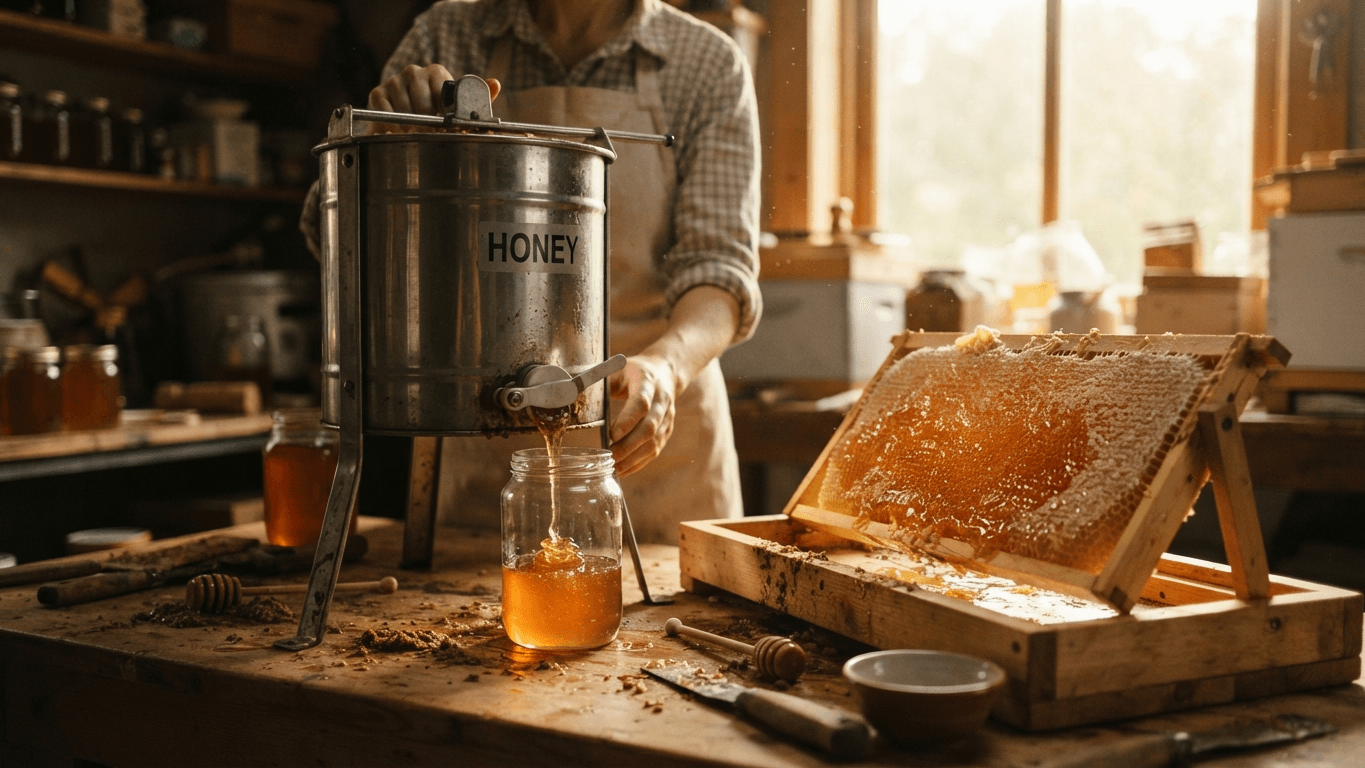
When to harvest
The single biggest beginner mistake is harvesting too early. Honey that is removed before it is ripe ferments in the jar, ruins your reputation with the first customer who tries it, and (in the US) is technically illegal to sell as "honey" because the moisture content exceeds 18.6%.
Three signals that a frame is ready:
- 80% or more of the cells are capped with white wax. This is the simplest visual check. Bees only cap honey when they've evaporated it down to ~18% water.
- The shake test passes. Hold a frame horizontally and shake it sharply over the hive. If honey drips out, it's unripe. Don't take it.
- Refractometer reads below 18.6%. A $25 honey refractometer settles any debate. Aim for 16-18% for the longest shelf life.
When does this happen? In most temperate Northern Hemisphere regions, the main honey harvest is late July through early September. The exact date depends on your nectar flow:
- Locust + clover regions: late June through July
- Goldenrod regions: September
- Buckwheat / fall flow: September - October
- Sourwood (Appalachia): mid-July only, very narrow window
- Tupelo (Florida panhandle): May
- Heather (Scotland): August - September
If you're in the Southern Hemisphere, shift everything six months.
Year-1 reality check
If you installed a nuc in spring 2026, you might have harvestable surplus by August. You might not. Year-1 hobbyist hives produce 0-20 lbs of surplus on average. The advice we give every first-year beekeeper:
> Take one frame. Or none. Leave the rest for the bees to overwinter on.
A first-year colony needs roughly 30-40 kg of stored honey to overwinter in a Northern climate. Stealing that and feeding sugar back is a bad trade — sugar is poorer nutrition, and you may not feed enough.
The exceptions: a strong package or nuc in a banner forage year can produce 40+ lbs of surplus. If you have it, take it. Just confirm the bottom box is heavy first.
Equipment options
You can harvest with $30 of gear or $3,000. Both work. Match the investment to the hive count.
1-3 hives: the crush-and-strain method
- Cut comb out of frames (using foundationless or starter-strip frames)
- Crush the comb in a food-grade bucket
- Strain through a fine mesh (paint strainer or honey-grade nylon)
- Bottle directly
Cost: $30 for buckets, strainer, and bottling jars. Yield: lower than extraction (you destroy the comb), but you don't need an extractor and the cut comb can be sold separately.
4-15 hives: a manual radial or tangential extractor
- 2-frame manual: $200-300
- 4-frame manual: $300-500
- Hand crank, no electricity needed
This is where most hobbyists land. A 4-frame manual extractor handles 15 hives in a long weekend.
16+ hives: motorised radial extractor
- 9-frame radial motorised: $1,200-2,000
- 20-frame radial motorised: $2,500-5,000
Radial designs spin both sides simultaneously and are 4-6x faster than tangential. Worth it once you pass 15 hives.
Universal supplies (any scale)
Track Your Harvest in HiveSense
Per-hive yield, moisture readings, and year-over-year comparisons.
- Uncapping tank or tray ($150-300)
- Uncapping fork or knife ($25-100)
- 5-gallon bottling buckets with valve gates ($60 each, buy 2)
- Coarse + fine strainer ($30 set)
- Refractometer ($25)
- Glass jars + lids in your chosen sizes
Skip these
- Heated knives (overkill for hobbyists; cold uncapping fork works fine)
- Honey filters labeled "ultra-fine" (anything below 600 microns strips pollen and disqualifies the "raw" label)
- Plastic squeeze bears (consumers in 2026 prefer hex glass; you'll get more per pound)
The harvest day, step by step
Plan for a full day. First-time harvesters take 4-6 hours for a single hive. Practiced operators do 5 hives in the same time.
Morning: prep the space
Pick a closed, bee-tight space. A garage, shed, or sealed kitchen. Open windows if your space has them and bees will arrive — you need it sealed.
Lay down plastic. Honey gets everywhere.
Set up your extractor, uncapping tank, bottling buckets, and bottling jars before you bring in any frames.
Pre-harvest: clear bees from the supers
Two methods, both effective:
Bee escape board (slow + gentle): a one-way valve placed below the honey super. Install it 24-48 hours before harvest. Bees walk down through the valve into the brood box and can't return up. Result: a nearly bee-free super.
Fume board (fast + chemical): a board with felt soaked in Bee Quick or Honey-B-Gone — non-toxic almond-oil-and-essential-oil mixtures that bees dislike. Place on top of the super; bees evacuate downward in 5-10 minutes.
Once bees are clear, lift the super, cover it, and walk it directly to the harvest space.
Mid-day: uncap and extract
For each frame:
- Hold over the uncapping tank
- Uncapping fork or knife along the frame, slicing off the wax cappings
- Place in extractor
- When the extractor is full, spin gently first (low speed for 30 seconds), then ramp up
- Reverse the frames or rotate, spin the second side
- Empty the extractor through the strainer into your bottling bucket
A 4-frame tangential extractor processes about 8 frames per cycle (you flip them midway). Plan on 15 minutes per cycle.
Afternoon: settle, bottle, label
After all frames are extracted, let the honey settle in a sealed bottling bucket for 24-48 hours. Air bubbles, fine wax particles, and dust rise to the top. Skim the foam.
Bottle through a 600-micron strainer into clean glass jars. Fill to the labeled net weight (use a kitchen scale; 12 oz of honey = 12 oz on the label, regardless of jar volume).
For labelling requirements (FDA, country-of-origin, lot codes), see chapter 5 of our beekeeping business plan. Running a commercial operation? The same page covers multi-apiary management, team seats, and compliance exports built for operators scaling past 50 hives. Curious what that scale is actually worth? See our beekeeping income breakdown.
Evening: clean up and return frames
Wash everything in hot water. Honey residue attracts ants, mice, and wax moths.
Return the wet (extracted) supers to the hive in the late afternoon or overnight. The bees will clean every drop within 48 hours. Then store the dry supers stacked tightly with paradichlorobenzene crystals or freezer-storage protocols against wax moths.
Storage and shelf life
Honey, properly stored, has an indefinite shelf life. Egyptian tomb honey from 3,000 years ago is still edible.
Storage rules:
- Glass or food-grade plastic only (never galvanised metal — honey reacts and lead-leaches old containers)
- Sealed at all times — honey is hygroscopic and will absorb humidity, fermenting if moisture exceeds 21%
- Cool, dark place — sunlight degrades quality slowly
Crystallization: all raw honey crystallises eventually. This is not a defect. Re-warm gently in a 40°C water bath if you want it liquid again. Better yet, market it as creamed honey and charge a 30% premium.
Tracking the harvest
The data from a harvest day is gold for the next year's decisions:
- Per-hive yield (lbs of capped honey)
- Per-hive moisture (refractometer reading)
- Floral source (best-guess based on apiary location and season)
- Which frames were heaviest
- Comb condition (replace dark brood-stained frames after 3 years)
Log all of this in HiveSense. The app's harvest record stores per-hive yield and moisture, and the year-over-year comparison view tells you which queens, apiaries, and management decisions are actually working.
What to do with your first jar
Set it aside. Date it. Open it on the same date next year.
Beekeeping is a long-feedback-loop game. The honey you eat in October 2026 is the result of every decision you made between March and August. The honey you'll eat in October 2027 is being decided now.
Want to track yields properly across multiple hives? Install HiveSense free — per-hive harvest records, moisture logging, and year-over-year comparison are core features, not Pro-tier upsells.
Track Your Harvest in HiveSense
Per-hive yield, moisture readings, and year-over-year comparisons.
Free to start. Works offline. No credit card required.
Use HiveSense for this
Commercial Beekeeping Software — Multi-Apiary & Team Seats
Multi-apiary tracking, team seats with role-based access, and CSV/PDF exports by apiary. Tell us about your operation and a real human replies within 24 hours.
Offline Beekeeping App — Works Without Internet
Log inspections, voice notes, and BLE sensor data with zero cell signal. Every feature works at the hive.
More from the blog
View allBeekeeping Gear Guide 2026: What Works With Your App
A complete 2026 beekeeping gear guide framed by app compatibility. Smokers, hive tools, suits, jackets, veils, hats, gloves, and the smart sensors that integrate directly with HiveSense.
The Future of Beekeeping: What the Next 20 Years Look Like
An honest look at where beekeeping is heading — sensored hives and AI alerts, vertical and urban apiaries, bee vaccines and RNA mite control, and climate-driven management — with a clear-eyed take on what is real now versus hype.