The Future of Beekeeping: What the Next 20 Years Look Like
An honest look at where beekeeping is heading — sensored hives and AI alerts, vertical and urban apiaries, bee vaccines and RNA mite control, and climate-driven management — with a clear-eyed take on what is real now versus hype.
The Short Answer
The next twenty years of beekeeping will look less like new gadgets bolted onto old boxes and more like a change in how beekeepers know what their bees are doing. The craft is shifting from reactive and manual — open the hive, look, guess — to continuous and data-driven, where the colony reports its own health between inspections.
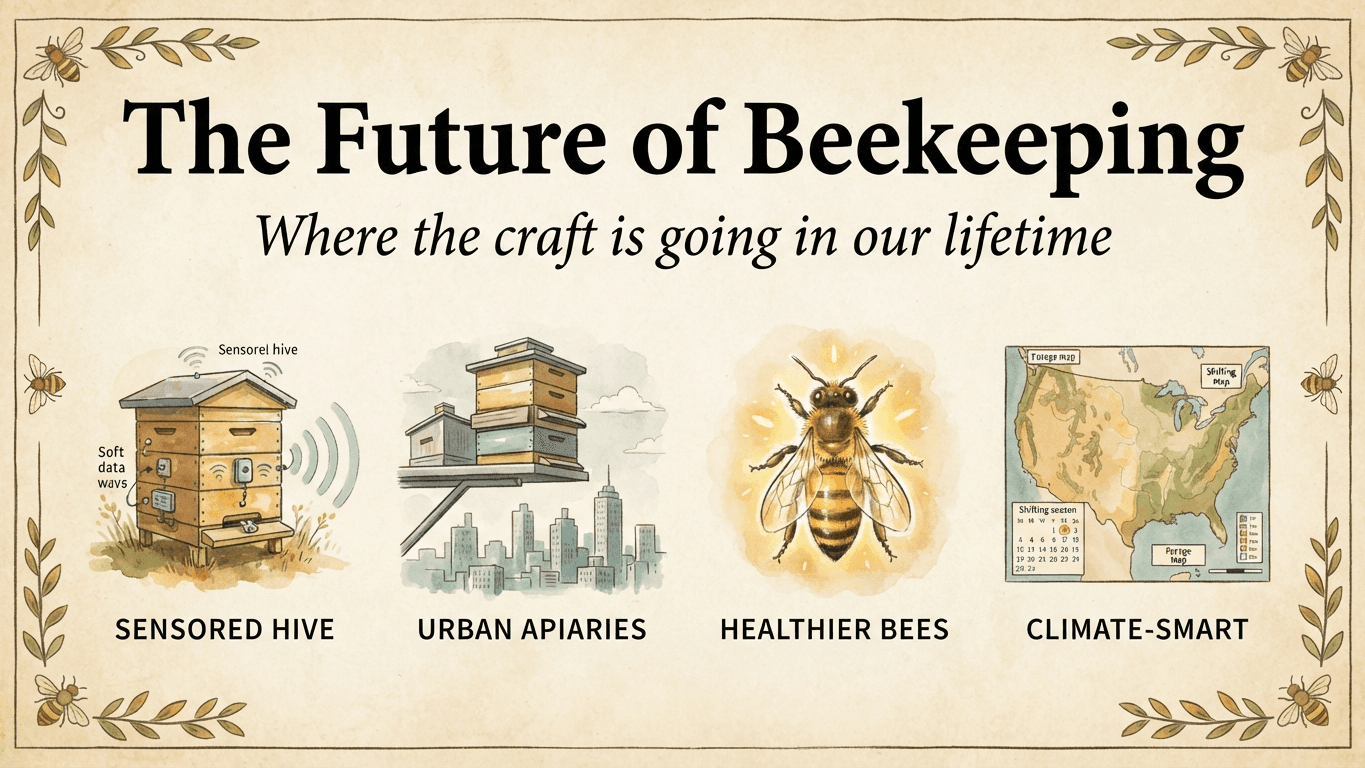
Four forces are driving it: sensored hives with AI alerts, denser urban and vertical apiaries, biotech for bee health, and climate-driven management. Below is an honest tour of each — what's real today, what's coming, and where the hype outruns the biology.
1. The Sensored Hive: Your Colony Reports Its Own Health
The most credible near-term future is already here — it just isn't standard yet. A modern monitored hive can carry:
- A microphone. A colony's sound changes before its behavior does. The pitch of a queenless hive, the roar of a colony preparing to swarm, the hum of robbing — all are detectable acoustically, often days before you'd spot them on a frame.
- A scale. Continuous weight tells you the exact day a nectar flow starts and stops, flags robbing, and shows winter stores burning down — without ever cracking the lid.
- Temperature and humidity probes. A healthy brood nest holds near 35°C. A deviation is one of the earliest warnings a colony can give.
- An entrance counter. Forager traffic as a vital sign.
What changed in the last few years is that the hardware got cheap, the batteries last a season on a small solar panel, and — most importantly — the software finally turns raw numbers into a decision. The future isn't "here's a graph." It's "treat this hive for varroa in the next ten days," or "colony 4 will likely swarm this weekend." The beekeeper's judgment stays central; the sensors just stop the surprises.
The honest caveat: sensors don't replace inspections, and a hobbyist with two hives in the backyard gets less from them than a sideliner running yards an hour apart. The value scales with how far you are from your bees.
Start Beekeeping the Data-Driven Way
HiveSense keeps your inspections, sensors, and treatments in one offline-first timeline — so you can manage by what the colony is actually telling you.
2. Vertical and Urban Apiaries: Honey Skyscrapers? Not Quite
This is the future people picture first — stacked, climate-controlled hive towers rising over cities like vertical produce farms. Some of it is real and growing: rooftop apiaries, hives built into building facades, pollinator infrastructure designed into transit corridors rather than bolted on afterward.
But here's the reality check that matters, and it's worth understanding before you imagine a honey skyscraper: a honey bee forages two to three miles from her hive. You can stack a hundred colonies on a rooftop, but they all draw nectar and pollen from the same surrounding landscape. The binding constraint on urban beekeeping isn't floor space — it's forage. Pack too many hives into one footprint and they compete, underperform, and stress the wild pollinators already there.
So the realistic future of urban beekeeping isn't vertical honey farms. It's dense networks of well-spaced city apiaries, coordinated by software — knowing how many colonies a neighborhood's bloom can actually support, and spreading them accordingly. Controlled-environment colonies (for season extension or pesticide protection) will have a place in research and specialty production, but the backyard and rooftop hive isn't going anywhere.
3. Biotech: The Fight Against Varroa Gets Smarter
If one thing reshapes bee health in the next two decades, it's biology, not hardware.
- Bee vaccines. In 2022 the USDA conditionally licensed the first vaccine ever approved for an insect — for American Foulbrood, delivered through the queen so her brood inherits resistance. It's the first of a category; expect more pathogens to follow.
- Targeted RNA mite control. The holy grail of varroa management is a treatment that kills the mite without harming the bee or leaving chemical residue in wax and honey. RNA-based approaches that target mite-specific genes are the most promising path there — fewer harsh miticides in the hive.
- Data-driven and genomic queen breeding. Selecting queens for hygienic behavior, mite resistance, and gentleness — increasingly guided by genomics and by the kind of colony records beekeepers are only now starting to keep systematically.
The throughline: the next decade of bee health is targeted, gentle, and bred in, rather than sprayed on.
4. Climate-Driven Beekeeping: Manage by the Bloom, Not the Calendar
Beekeeping has always run on a seasonal calendar passed down locally. Climate change is breaking that calendar. Blooms now arrive earlier and less predictably; bees and the flowers they depend on can fall out of sync. A management schedule that worked for your area in 2005 can leave you feeding too late or supering too early today.
The future here is management timed to this year's conditions, not the date on the wall — software that watches local bloom, weather, and your own hive data and shifts your feeding, splits, swarm checks, and supering accordingly. Layer on AI forage mapping (where to place hives, what to plant) and shared regional intelligence — anonymized signals like "varroa is spiking in your county" or "the flow just started fifteen miles north" — and individual beekeepers start to benefit from the whole region's data.
What This Means for You
You don't have to wait twenty years to beekeep this way. The shift that matters most — managing from records and trends instead of memory and guesswork — is available today, and it's the foundation everything else builds on. Sensors plug into it. AI alerts read from it. Regional intelligence is just everyone's records, pooled.
That's the bet behind HiveSense: keep your inspections, your sensor readings, your treatments, and your queen history in one offline-first timeline, so that whatever the next decade adds — a microphone, a vaccine record, a county-level mite alert — you already have the habit and the history to use it. The future of beekeeping isn't a robot that keeps bees for you. It's a beekeeper who finally knows what their bees have been trying to tell them all along.
Start Beekeeping the Data-Driven Way
HiveSense keeps your inspections, sensors, and treatments in one offline-first timeline — so you can manage by what the colony is actually telling you.
Free for up to 15 hives. No credit card required.
More from the blog
View allSmart Beehives: The Latest Innovations in 2026
What actually makes a beehive "smart" in 2026 — the sensors, solar power, AI alerts, and apps behind modern hive monitoring, and which innovations are worth the money for a hobbyist.
Honey Bee Vaccine 2026: What Beekeepers Need to Know
The honey bee vaccine timeline, demystified: Dalan's December 2022 conditional license, the November 2025 USDA clinical submission, and what 2027 full licensure means for your apiary planning.