Honey Bee Vaccine 2026: What Beekeepers Need to Know
The honey bee vaccine timeline, demystified: Dalan's December 2022 conditional license, the November 2025 USDA clinical submission, and what 2027 full licensure means for your apiary planning.
The short answer
The world's first vaccine for an insect — Dalan Animal Health's American Foulbrood (AFB) vaccine for honey bees — has held a USDA conditional license since December 2022. Dalan submitted full clinical efficacy data to the USDA in November 2025 following a successful summer 2025 trial season. Full licensure is expected no earlier than 2027. Until then, the vaccine is available in limited US markets through licensed beekeeping queen producers, but year-one hobbyists do not need to plan for dosing yet.
If a beekeeping blog or PDF tells you the vaccine "fully launches in March 2026," it is misreading the timeline. There is no March 2026 USDA milestone. The two real dates are December 2022 (conditional license) and November 2025 (clinical efficacy data submission). Everything else is forecasting.
What the vaccine actually does
American Foulbrood is the disease beekeepers fear most. It is a spore-forming bacterial infection (Paenibacillus larvae) that destroys brood, contaminates equipment for decades, and in many US states is legally required to be treated by burning the entire colony, equipment included. There is no antibiotic that eradicates the spores once they've formed.
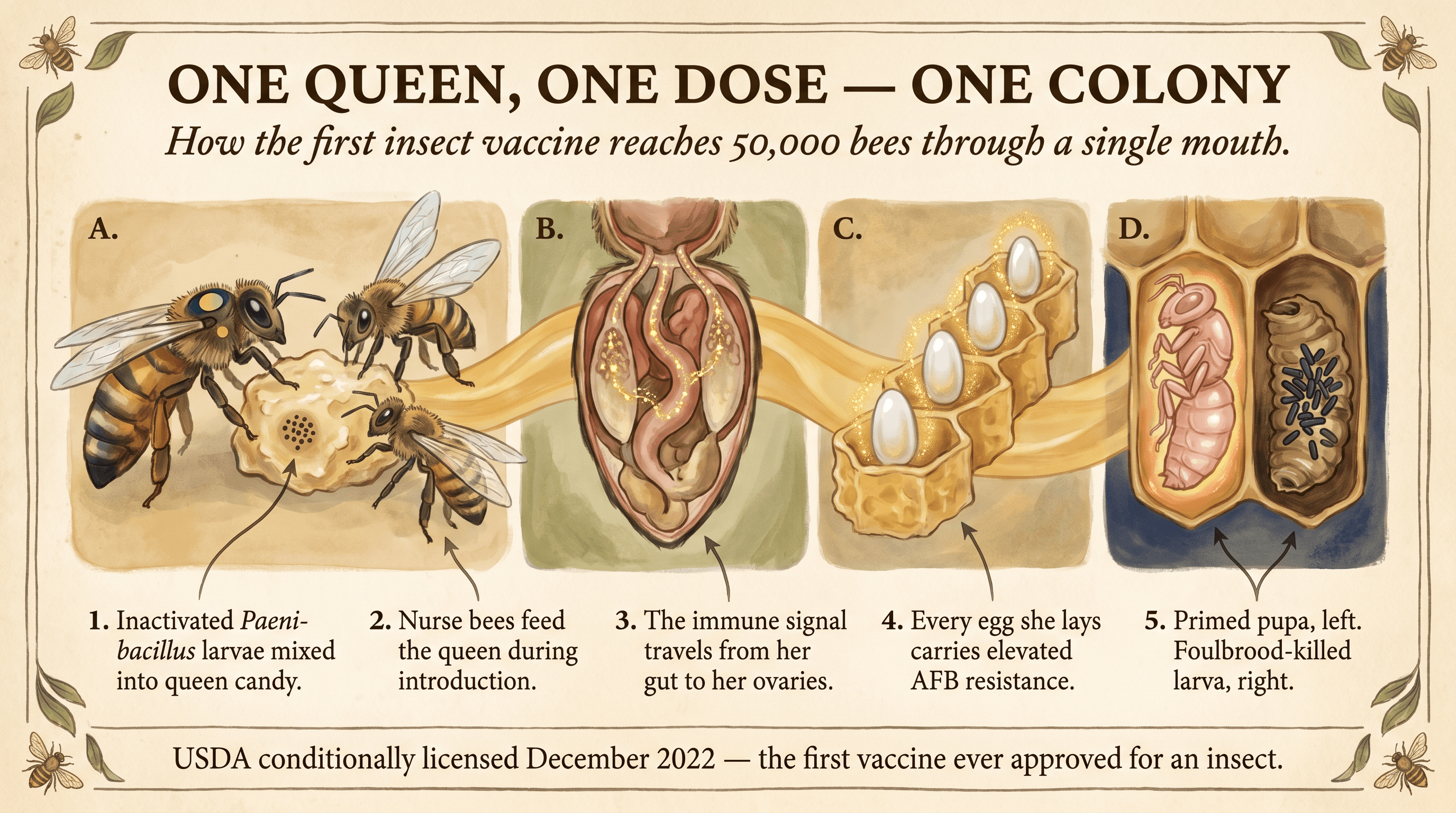
Dalan's vaccine works through trans-generational immunity: the queen consumes vaccinated worker jelly (mixed into the queen candy used during shipping or introduction), and the immunity passes through her into her eggs. The resulting brood expresses elevated immune response to P. larvae spores. It is not a needle. There is no "vaccinating the bees" in the traditional sense — the queen is the delivery vehicle for the entire colony.
This mechanism is what makes the vaccine workable at scale. You don't treat 50,000 individual workers; you treat one queen, and her line carries the protection.
The timeline, with no forecasting fog
| Date | Event |
|---|---|
| December 2022 | USDA grants conditional license. Limited commercial availability begins through partnered queen producers. |
| 2023–2024 | Field deployment in cooperation with commercial queen breeders; Dalan collects real-world efficacy data alongside controlled trials. |
| Summer 2025 | Successful efficacy trial season. Field results meet the threshold required for full-license review. |
| November 2025 | Dalan submits clinical efficacy data to the USDA Center for Veterinary Biologics. |
| 2026 | USDA review period. No new product release in 2026. Conditional-license availability continues through partnered queen producers. |
| 2027 (expected) | Earliest realistic date for full USDA licensure. Broader commercial availability follows. |
Sources for these dates: Dalan Animal Health's November 2025 press release, USDA Center for Veterinary Biologics conditional-license documentation, and the AVMA's ongoing coverage of the program.
Should you buy a vaccinated queen in 2026?
Log Treatments and Vaccines in HiveSense
Track every treatment, every dose, and every queen on the same offline timeline.
For a year-1 hobbyist: No. You will spend the year learning frame technique, queen-spotting, and how to read brood-pattern. AFB is rare in well-managed first-year colonies, and the cost premium for a vaccinated queen is better deployed on a proper inspection routine and a basic sensor stack. Vaccinated queens are not yet widely available outside specific commercial channels, and you may not be able to get one.
For a sideline beekeeper (5–30 hives) in an AFB-active region: Maybe. If you're in a state where AFB is endemic — Pennsylvania, parts of California, the upper Midwest — and you've had any neighboring beekeeper report a case in the last three years, the vaccinated-queen premium is justifiable insurance. Buy from a queen producer participating in the Dalan program; ask for written confirmation of vaccination.
For commercial operations: Yes, and you almost certainly already know this. Migratory pollinators moving thousands of hives between almond, apple, and blueberry contracts have the highest AFB exposure profile in beekeeping. The economics of one bad outbreak — burning 200+ colonies and their equipment — make vaccinated queens straightforwardly cost-effective.
What this changes about year-1 planning
Almost nothing. The vaccine is not a substitute for inspection, hygiene, or honest record-keeping. American Foulbrood is identified by the same field tests it has always been identified by: the rope test, the matchstick test, and the smell. Vaccinated colonies still need inspecting. Vaccinated queens still get superseded. Vaccinated apiaries still need a working treatment record for varroa, nosema, and small hive beetle.
What the vaccine does change is the disaster-recovery profile. A region that lost 40% of its apiaries to a 2018 AFB outbreak might lose 5% in 2030, when most queens in commerce carry the trait. That bends the long-term industry curve. It does not bend your year-1 decision tree.
How to log a vaccinated queen in your records
If you do introduce a vaccinated queen, the data hygiene that pays back is unglamorous:
- Source documentation. Save the queen producer's confirmation email or shipping document — vaccinated, unvaccinated, lineage, year. Photograph it before you lose it.
- Introduction date and method. Push-in cage, candy release, direct release. Note the date the cage was opened.
- First brood evaluation. Two weeks after introduction, evaluate the first capped brood for pattern and density. Vaccinated queens are not magically better layers — pattern still tells you whether she took.
- Annual mortality outcomes. Compare colony losses across vaccinated and unvaccinated queens over multiple seasons. This is the only data that will tell you whether the vaccine is paying for itself in your specific apiary.
This is exactly the kind of record-keeping that falls apart in paper notebooks and spreadsheets. HiveSense logs queen lineage, introduction events, and per-colony mortality on the same offline timeline as inspections, treatments, and sensor readings — so the vaccine's effect on your apiary is visible in year-over-year reports, not lost to memory. Documented practices like this are also what the wider honey traceability and verification trend increasingly rewards.
What about other bee vaccines?
Dalan is also conducting research on a European Foulbrood (EFB) vaccine and exploring vaccines targeting Deformed Wing Virus (DWV) — the varroa-vectored virus responsible for the majority of winter colony losses in the developed world. None of these are in clinical-data review yet. Realistic timeline for any of them: 2028 at the earliest, almost certainly later.
The honey bee vaccine pipeline is real, peer-reviewed, and slow. Treat it like any other multi-year regulatory process — with patience, not hype.
When to call it: vaccine vs. management
If you can answer "yes" to two or more of these, prioritize a vaccinated queen at your next requeening:
- AFB has been confirmed in your county or state apiary inspection report within the last 5 years.
- You buy or split queens annually rather than letting colonies supersede.
- You run more than 10 hives, especially across multiple yards.
- You participate in any pollination contract that mixes your hives with hives from other operations.
If you can't, prioritize the boring infrastructure first: a real hive inspection routine, a BroodMinder sensor on at least one hive, and an honest treatment log. The vaccine is leverage on top of that foundation, not a replacement for it.
The HiveSense angle
We track three things that matter for the vaccine era: queen lineage (so you can see which queens were vaccinated and which weren't), treatment events (so AFB-suspect cases trigger an immediate inspection log), and sensor anomalies (so brood-temperature collapse — one of the early signals of severe brood disease — flags before you visit the yard).
Install HiveSense free for up to 15 hives. Queen tracking and basic treatment records are on the free tier; BroodMinder integration is part of Pro. The bee vaccine is a multi-year story; the only way you'll know whether it worked in your apiary is to start logging now.
Log Treatments and Vaccines in HiveSense
Track every treatment, every dose, and every queen on the same offline timeline.
Free to start. Works offline. No credit card required.
More from the blog
View allThe Future of Beekeeping: What the Next 20 Years Look Like
An honest look at where beekeeping is heading — sensored hives and AI alerts, vertical and urban apiaries, bee vaccines and RNA mite control, and climate-driven management — with a clear-eyed take on what is real now versus hype.
How to Harvest Honey: First Year Step-by-Step (2026 Guide)
A complete step-by-step guide to harvesting honey for the first time. When to harvest, equipment options, the day-of process, bottling, labelling, and how much to leave for the bees.