Varroa Mite Treatment Guide: When, What & How to Treat
Complete guide to Varroa mite treatment for honey bees. Covers oxalic acid, formic acid, Apivar, thymol, the Varroa mite life cycle, and integrated pest management (IPM) strategies for every season.
Why Varroa Treatment Is Non-Negotiable
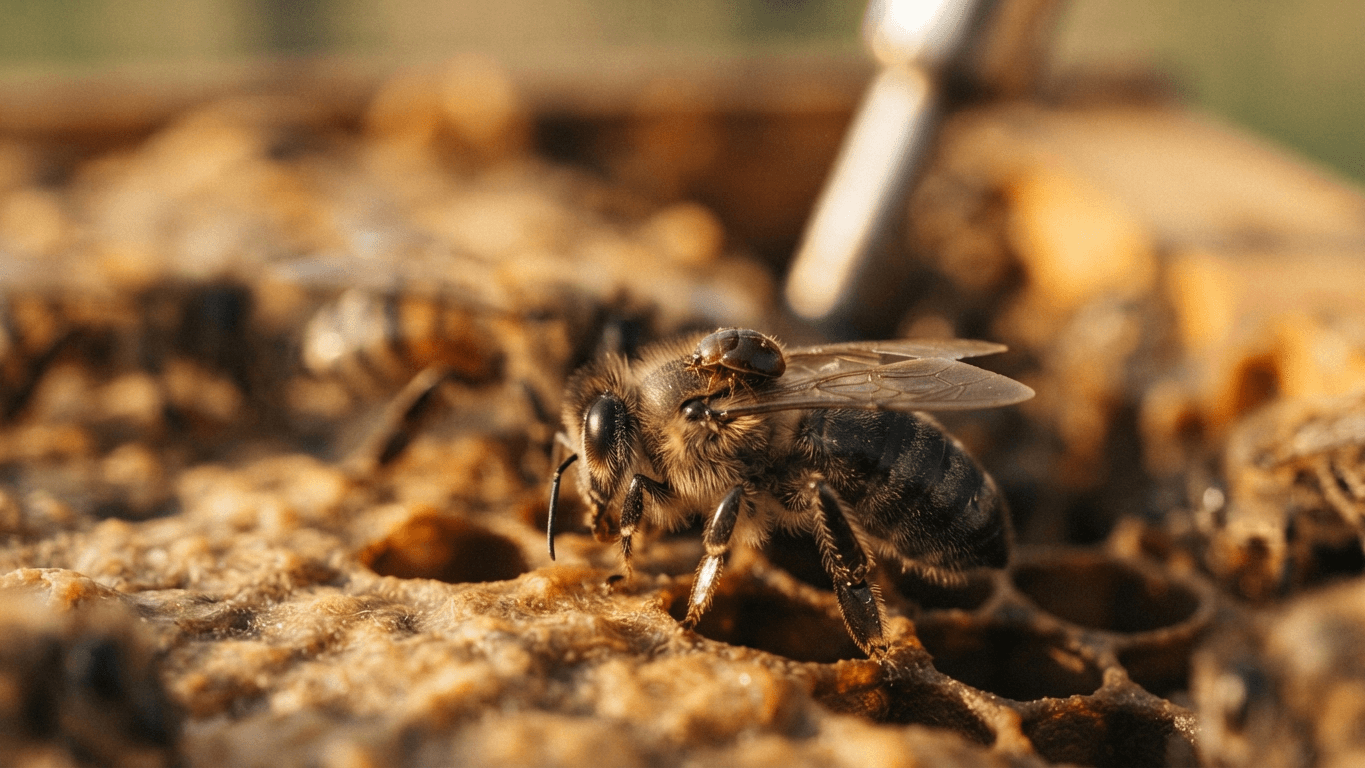
Varroa destructor is the single greatest threat to managed honey bee colonies worldwide. These parasitic mites feed on bee fat bodies (not hemolymph, as previously thought), weakening individual bees and transmitting deadly viruses like Deformed Wing Virus (DWV) and Acute Bee Paralysis Virus (ABPV).
Left untreated, a colony will typically collapse within 1-3 years. Effective Varroa management is not optional — it's the foundation of colony survival.
The Varroa Mite Life Cycle (Why Timing Matters)
You can't treat Varroa effectively — or know when to treat for Varroa mites — without understanding the life cycle of a Varroa mite, because the mite spends much of its life hidden where most treatments can't reach it. The cycle has two phases:
- Phoretic phase (on adult bees). A female mite rides on an adult bee, feeding on its fat body. This is the only phase where contact treatments like oxalic acid can reach her. It lasts about 5–11 days.
- Reproductive phase (inside capped brood). The mated female slips into a larva's cell just before it's capped — preferring drone brood — and lays eggs there. Inside the sealed cell she produces new mites that mature alongside the developing bee, safe from treatments that can't penetrate the cap. This is why a single mite becomes many, and why mite loads explode in late summer.
The whole cycle takes roughly 10 days for a mite to develop, and a female may reproduce several times. Two consequences drive every treatment decision below: (1) most mites are hidden in capped brood at any given moment, so treatments that only kill phoretic mites need repeating or a broodless window; and (2) because mites reproduce in capped brood, populations grow fastest exactly when your colony is raising the most brood — late summer — which is why fall treatment timing is so critical to getting a colony through winter.
Step 1: Monitor Before You Treat
Never treat blindly. Regular monitoring tells you when treatment is needed and whether your treatment worked.
The Alcohol Wash (Most Accurate)
- Collect ~300 bees (half cup) from a brood frame (avoid the queen's frame)
- Place in a jar with ~2 tablespoons of rubbing alcohol (70% isopropyl)
- Shake vigorously for 60 seconds
- Strain through #8 hardware cloth
- Count the mites that fall through. Use our varroa mite count calculator to get an accurate percentage.
Treatment thresholds by season. The Honey Bee Health Coalition's Tools for Varroa Management (9th edition, June 2026) sets a threshold for each phase of the colony year. Its Table 1:
| Colony phase | Treat promptly at | On a 300-bee wash |
|---|---|---|
| Dormant (sample just before clustering) | 1% or more | 3+ mites |
| Population increase (spring build-up) | 1% or more | 3+ mites |
| Peak population (summer) | 2% or more | 6+ mites |
| Population decrease (late summer and fall) | 2% or more | 6+ mites |
The guide calls these conservative estimates and says thresholds vary by region, so check with your state or provincial apiarist. Our Varroa threshold tool does the arithmetic.
The Sugar Roll (Non-Lethal Alternative)
Same method, but use powdered sugar instead of alcohol. Slightly less accurate (~75% of mites dislodged vs ~95% with alcohol), but the bees survive.
Natural Mite Drop
Place a sticky board on the bottom board for 24-72 hours. Count the mites that fall naturally. This gives a rough population estimate but is less precise than a wash.
Step 2: Choose Your Treatment
Different treatments work best at different times of year. Here's the complete toolkit at a glance as a varroa treatment chart, then the detail on each:
| Treatment | Type | Best season | Brood OK? | Temp range | Supers on? | Efficacy |
|---|---|---|---|---|---|---|
| Oxalic acid | Organic acid | Late fall/winter (broodless) | No (weak with brood) | Any | No | 90–95% broodless |
| Formic acid (Formic Pro) | Organic acid | Spring/fall | Yes (penetrates brood) | 50–85°F | Yes | 85–95% |
| Thymol (Apiguard) | Essential oil | Fall | Partial | 60–105°F | No | 75–90% |
| Amitraz (Apivar) | Synthetic | Spring/fall | Partial | Any | No | 95%+ |
| Drone brood removal | Mechanical | Spring/summer | n/a | n/a | Yes | Supplemental |
The right choice depends on the season, whether brood is present, and whether your honey supers are on. Here's the detail on each.
Oxalic Acid (OA)
Best for: Late fall/early winter treatment when there's little to no capped brood.
Oxalic acid is a natural organic acid found in plants like rhubarb. It's highly effective against phoretic mites (those riding on bees) but cannot penetrate capped brood cells.
Methods:
- Vaporization (OAV): The current US Api-Bioxal label (EPA Reg. No. 73291-2, amended June 2025) says 4 g per brood chamber, sublimated with a vaporizer through the bottom entrance; the Honey Bee Health Coalition's 2026 guide also gives 4 g per brood box. Older Api-Bioxal labels and some generic oxalic acid labels say 1 g, so dose by the label on the product you actually bought. Seal the entrance during treatment (2-3 minutes), then ventilate. Repeat 3 times at 5-7 day intervals if brood is present.
- Dribble: The Api-Bioxal label mixes 35 g of oxalic acid into 1 L of warm 1:1 sugar syrup (about a 2.8% solution), then trickles 5 ml onto the bees in each occupied bee space, up to 50 ml per colony. One-time application only per brood-free period.
Never Miss a Treatment — Set Reminders in HiveSense
Track treatments, log mite counts, and get timely reminders.
Efficacy: 90-95% when applied broodless. Much lower with capped brood present. If you want a broodless window in summer rather than waiting for winter, see summer OA timing and queen caging.
Withdrawal period: None required for honey (when used as directed).
Temperature: Can be applied at any temperature (a major advantage for late-season treatment).
Formic Acid
Best for: Late summer treatment — it penetrates capped brood cells.
Methods:
- Formic Pro strips: Apply 2 strips per colony for 14 days. The controlled release of formic acid vapor kills mites on bees AND under cappings.
- MAQS (Mite Away Quick Strips): Similar application, 7-day treatment.
Efficacy: 60-85% (variable based on temperature and ventilation).
Temperature requirement: 10-29.5°C (50-85°F). Higher temperatures increase risk of queen damage.
Important: Can cause queen loss in ~3-5% of colonies, especially in hot weather. Ensure good ventilation.
Amitraz (Apivar)
Best for: Extended fall treatment when you need reliable, consistent results.
Apivar is a synthetic acaricide delivered via plastic strips hung between brood frames.
Application: One strip per five frames of bees in each brood chamber (usually 2 per full brood box), hung in the brood nest where bees walk on both sides. How long they stay in depends on which product is in the box. The original Apivar label says 42 days, with a 56-day maximum. Apivar 2.0's US label (December 2025) says at least 42 days, 70 days when brood is present, and never more than 70. We walk through the Apivar 2.0 label in our rotation guide.
Efficacy: 95%+ when used correctly and mites haven't developed resistance.
Honey supers: Never on while strips are in. The original label says to remove strips 14 days before supering; Apivar 2.0 has no withholding period, so supers can go on as soon as the strips come out.
Resistance concern: Amitraz resistance is emerging in some regions. Rotate treatments to preserve efficacy. Our 3-year amitraz rotation plan lays out one way to do it.
Thymol (Apiguard, ApiLifeVar)
Best for: Late summer/early fall treatment in moderate climates.
Application: Place gel trays or vermiculite pads on top of the brood frames. Apply in 2-week cycles (typically 2-3 applications).
Efficacy: 70-90% depending on temperature and colony size.
Temperature requirement: 15-30°C (59-86°F).
Note: Bees may temporarily remove honey from frames near the treatment. Can affect honey flavor if supers are on.
Drone Brood Removal (Mechanical)
Best for: Spring management to reduce mite reproduction.
Varroa mites prefer drone brood (10x more attractive than worker brood). By providing a drone comb frame, letting the queen lay in it, and removing it once cells are capped, you trap and remove a significant portion of the mite population.
Efficacy: Reduces mite buildup by 30-50% when combined with other methods.
Timing: April-June in northern hemisphere. Remove capped drone comb every 3 weeks.
Step 3: Varroa Mite Treatment Schedule by Season
Spring (March-May)
- Monitor: First sugar roll or alcohol wash when brood rearing begins
- Treat if needed: OAV (if broodless period available) or drone brood trapping
- Goal: Start the season with low mite levels
Summer (June-August)
- Monitor: Monthly checks. Mite populations grow exponentially with brood production
- Watch for: Mite counts climbing toward treatment threshold
- Treat if needed: Formic acid (penetrates brood), especially after honey harvest
Fall (September-November)
- Critical treatment window: This is the most important treatment of the year
- Why: Fall-reared "winter bees" must be healthy to survive until spring. High mite loads now = colony death in January. Pair fall mite control with strong winter feeding so the colony goes into winter both low-mite and well-fed
- Treat: Apivar strips (42 days minimum; see the label on your box for the maximum), or formic acid if temperatures allow
- Monitor after treatment to confirm efficacy. Our September checklist covers the verify-then-rotate routine
Winter (December-February)
- OAV treatment: During the natural broodless period (typically December-January in northern climates). This is when OA is most effective.
- Timing: Treat when nighttime temperatures drop below 0°C for several weeks, ensuring minimal capped brood
Step 4: Track Everything
Varroa management only works if you track your treatments and mite counts over time. Recording:
- Date and method of each treatment
- Pre-treatment mite count (to justify the treatment)
- Post-treatment mite count (to verify it worked)
- Colony-specific notes (some colonies may have higher mite loads than others)
This data helps you time future treatments, identify resistant mite populations, and evaluate which methods work best in your climate and with your bee stock.
Beekeeping apps like HiveSense's varroa tracker automate this tracking — log treatments, set reminders for follow-up counts, and view mite load trends across all your colonies in one dashboard.
Common Mistakes
- Treating too late: By the time you see deformed wing bees, the damage is done. Monitor early and treat at threshold.
- Not monitoring after treatment: A treatment that didn't work is worse than no treatment (you've lost time). Always do a follow-up count 7-10 days after treatment ends.
- Using only one treatment type: Rotate between chemical classes to prevent resistance. Don't use Apivar every single time.
- Treating during honey flow with improper withdrawal times: Follow label directions for withdrawal periods before adding honey supers.
- Skipping the fall treatment: The fall treatment protects your winter bees. It's the single most important treatment of the year.
Frequently Asked Questions
When should I treat for varroa mites?
Treat when a mite wash crosses the threshold for the colony's phase, not on a fixed date. The Honey Bee Health Coalition's Tools for Varroa Management (9th edition, June 2026) says to treat promptly at 1% or more (3 mites in a 300-bee wash) during spring build-up and dormancy, and at 2% or more (6 mites) from peak population through fall. The late-summer and fall treatment matters most, because it protects the winter bees.
What is the best varroa mite treatment?
There isn't one best product. The right choice depends on the season, whether brood is present, the temperature, and whether honey supers are on. Oxalic acid works best in a broodless window, formic acid reaches mites under cappings and can be used with supers on within its temperature range, thymol needs moderate temperatures, and amitraz strips such as Apivar give a long, steady treatment where resistance isn't a problem. Rotating between chemical classes keeps each of them working.
How long do Apivar strips stay in the hive?
It depends on the label. The original Apivar label says 42 days, with a 56-day maximum. The Apivar 2.0 US label (EPA Reg. No. 87243-5, December 2025) says at least 42 days, 70 days when brood is present, and never more than 70. Both use one strip per five frames of bees in each brood chamber. Follow the label on the box you bought.
How do I know if a varroa treatment worked?
Repeat the same wash on the same hives after the treatment period ends and compare it with your pre-treatment count. The Honey Bee Health Coalition's guide says post-treatment alcohol washes should generally come in under 2%. If the count is still above threshold, apply a different suitable treatment without delay, and log both counts so you can see whether a product is losing its effect in your yard.
Get the printable PDF version of this guide.
Field-ready pages you can print and take to the yard. One email, then it lands in your inbox.
More from the blog
View allAmitraz Resistance 2026: The 3-Year Rotation Plan
Amitraz resistance is documented in US mite populations — the Y215H marker has a name and the 2026 field data is in. Here is the 3-year rotation plan that keeps every treatment class working: the table, the wash-test check, and the 10–14 day verification step.
Winter Oxalic Acid: Treating in the Broodless Window
Why winter oxalic acid works best in the broodless window, how to tell you are in it, the current US label doses, and when to leave the hive closed.