How to Learn Beekeeping in 2026: A Practical Guide
A complete plan for learning beekeeping in 2026 — beginner courses, the books worth reading, finding a mentor, and the digital field notebook that compounds what you learn.
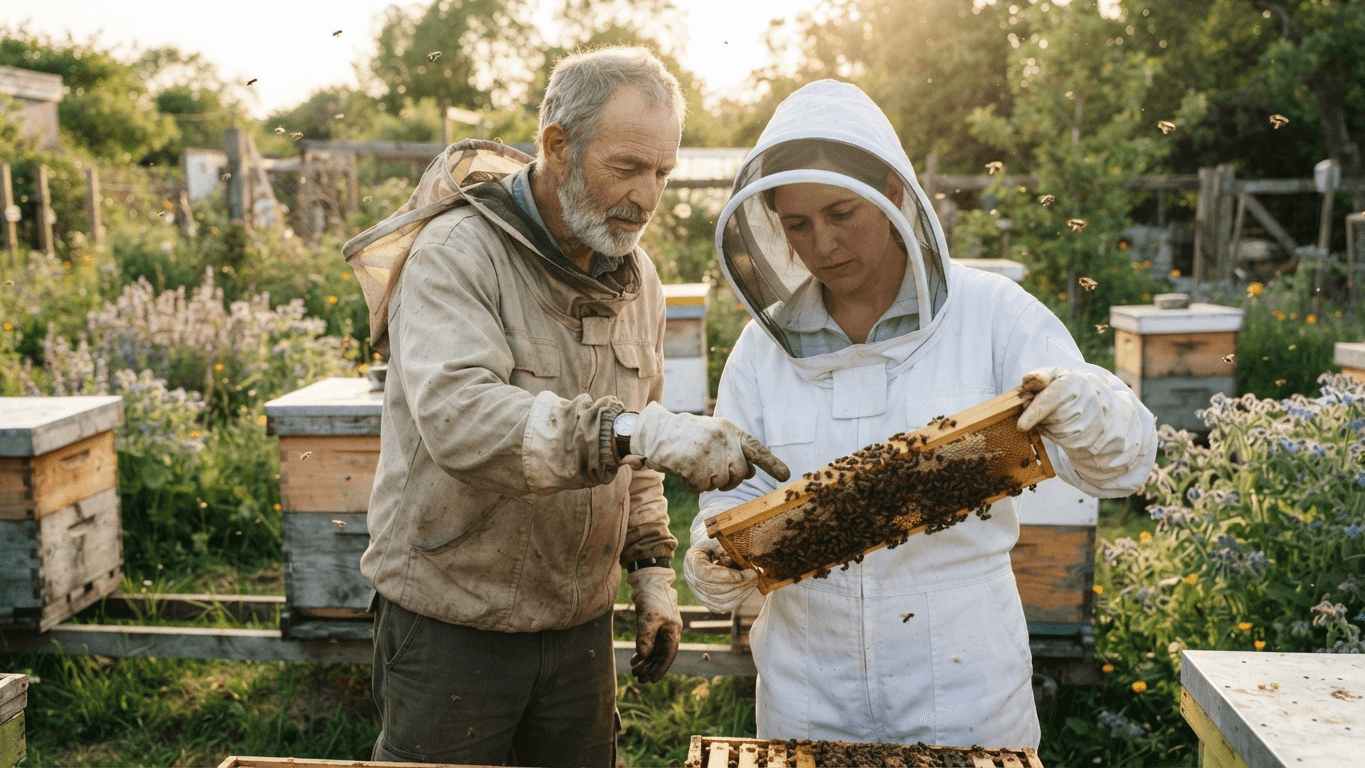
Three paths, one outcome
There are three real ways to learn beekeeping. Most people use all three at once, in different proportions. The mistake is leaning on one and skipping the others.
- Books and courses give you the structured knowledge — biology, equipment, treatments, calendar.
- Mentors and clubs give you the situational judgment — when this signal really means swarming vs. when it means a warm afternoon.
- Hands-on practice with real bees turns both into reflex.
Pick a course, find a mentor, and order a nuc. Then do the work. Below is the breakdown.
Step 1: Beginner courses
A full beginner course is 8-12 hours of structured instruction over 4-6 weeks. The good ones are run by state extension services, beekeeping associations, or experienced commercial beekeepers.
What to look for:
- A live in-person or online cohort (recorded-only courses get abandoned)
- A scheduled apiary visit (you'll learn more in 30 minutes at a real hive than 8 hours of slides)
- A workbook or syllabus, not just lectures
- Cost between $50-300; over $400 is usually a brand premium, not better content
Where to find one in 2026:
- US: your state extension service (search "[state] beekeeping extension")
- US clubs: county-level clubs through the American Beekeeping Federation directory
- UK: BBKA basic and general husbandry programs
- DE/FR/EU: local Imkerverein / Syndicat / VIM
- Online (worldwide): University of Florida's Master Beekeeper program, the Honey Bee Health Coalition certificate, David Burns' EAS-affiliated online programs
Skip: "buy our hive and the course is free" packages from gear retailers. The course is usually a thin justification for a $600 starter kit.
Step 2: The four books worth your time
Beekeeping has more bad books than any other hobby. Most beginner books are 80% recycled basics and 20% the author's pet theories. These four are different.
"First Lessons in Beekeeping" by Keith Delaplane (revised 2020+ editions)
The cleanest beginner manual in print. Short, photographed, accurate. Read this first. About 180 pages.
"The Beekeeper's Bible" by Richard Jones and Sharon Sweeney-Lynch
A reference book, not a how-to. Equipment, history, recipes, troubleshooting. The book you keep on the shelf and pull down when something goes wrong.
"Honeybee Democracy" by Thomas Seeley
Not a how-to book. It's the science of how a swarm picks a new home, written by the Cornell researcher who decoded the process. Reading it changes how you see your bees forever.
"The Practical Beekeeper" by Michael Bush (or the website at bushfarms.com)
Use HiveSense as Your Field Notebook
Voice-note inspections, log treatments, sync across devices. Free for 15 hives.
The natural / treatment-free school of thought. Strong opinions, useful even if you disagree with all of them. Reading from a different camp sharpens your own thinking.
Step 3: A mentor
The single highest-leverage move in your first year. A mentor with 5+ years of experience will save you from at least three expensive mistakes — and they'll do it for free, because that's the culture. For more on where to look and how to get the most out of the relationship once you have one, see our full guide to finding a beekeeping mentor.
How to find one:
- Join your local club — our directory of local clubs and beekeepers is a good place to start if you don't already know where yours meets. Show up to the in-person meetings. Volunteer to help at field days.
- Email three local beekeepers and ask for 30 minutes of their time. Buy them coffee. Most will say yes.
- Take your beginner course in person — the instructor is often willing to mentor a few students per cohort.
What a good mentor does:
- Comes to your apiary at least twice in your first season
- Answers texts within a day during inspection-decision moments
- Lets you watch them work their hives 2-3 times
- Tells you the truth about your colony (often "this isn't going to make it")
What you owe a mentor:
- Don't waste their time. Read the book chapter before asking the question.
- Help in their apiary — extracting honey, building boxes, swarm calls.
- Pass it forward when you have 5 years under your belt.
Step 4: Your first hive
You'll learn more in your first 90 days with bees than in 10 books. Buy a nuc — not a package — for your first colony. The brood is established, the queen is laying, you skip the riskiest two weeks.
For the gear and bee-sourcing details, see our complete beekeeping starter kit — that page has the comparison table, real 2026 SKU prices, and the option to download the 13-page Beginner Starter Guide PDF.
Step 5: The field notebook problem
Here's where most beekeepers lose the compounding advantage of practice.
Beekeeping is a long-feedback-loop hobby. The decision you make in May affects the colony's health in October. Without good records, you literally cannot learn from your own experience — by the time you'd need to recall what you did, you've forgotten.
The traditional solution is a paper notebook. The problem with paper notebooks: gloved hands, falling-apart pages, lost notebooks, illegible field-day handwriting. Most beekeepers we've talked to have started a paper logbook and abandoned it by July.
The HiveSense alternative:
- Voice notes — talk into your phone with your gloves on. The transcription happens in the background.
- Photos auto-tagged to the hive and the inspection date.
- Treatment logging with reminders for the next dose or threshold check.
- Offline-first — works at the back forty with no signal.
- Sync across devices — your apiary partner sees the same record.
- Free for up to 15 hives.
Check out our offline beekeeping app for a full feature walkthrough or consult our glossary for unfamiliar terms. Use it from the very first inspection. The data accumulates into year-2 muscle memory in a way no paper notebook ever has.
Step 6: Year-round learning
Once you've made it through the first season alive, the next layer of learning kicks in:
- Conferences. EAS (Eastern Apicultural Society), Heartland Apicultural Society, your state association's annual meeting. Two days of intermediate content for the cost of a hotel and registration.
- Online forums. r/Beekeeping is decent if you screen for advice from regulars; Beesource forums for old-school depth.
- Master Beekeeper programs. Multi-year structured progression — the closest thing to a credential. UF's program is the best-known in the US.
- Research papers. PubMed and Apidologie publish primary research. Most is dense, but reading 2-3 papers per year keeps you current with treatments and disease developments.
- Other regions' practices. A UK beekeeper and a Texas beekeeper face different problems. Reading outside your region builds adaptive skill.
What's on your plate
If your first spring is the next one:
- Sign up for a beginner course as soon as enrolment opens — most run over winter
- Read Delaplane's book in the next two weeks
- Reach out to two local beekeepers and ask for coffee
- Order a nuc early; good suppliers sell out months before their spring delivery window
- Install HiveSense on your phone before the bees arrive
The order matters. Course before bees, mentor before the first inspection, app before the first paper notebook entry. Otherwise you'll learn the long way — which is also a valid path, just one that involves more dead colonies than necessary.
A first-year beekeeper with a mentor, a real course, and a digital field notebook is operating at year-3 efficiency. That's the compounding the boring infrastructure unlocks.
Use HiveSense as Your Field Notebook
Voice-note inspections, log treatments, sync across devices. Free for 15 hives.
Free to start. Works offline. No credit card required.
More from the blog
View allHow to Start Beekeeping: A First-Year Roadmap
A practical first-year roadmap for starting beekeeping — what to buy, when to order bees, what your first season actually looks like, and the costs and mistakes to plan around.
How to Harvest Honey: First Year Step-by-Step (2026 Guide)
A complete step-by-step guide to harvesting honey for the first time. When to harvest, equipment options, the day-of process, bottling, labelling, and how much to leave for the bees.