Beekeeping Logbook & Queen Calendar: What to Track
What belongs in a beekeeping logbook and how a queen rearing calendar works — the records that actually improve your beekeeping, on paper or in an app.
Why Keep a Beekeeping Logbook at All
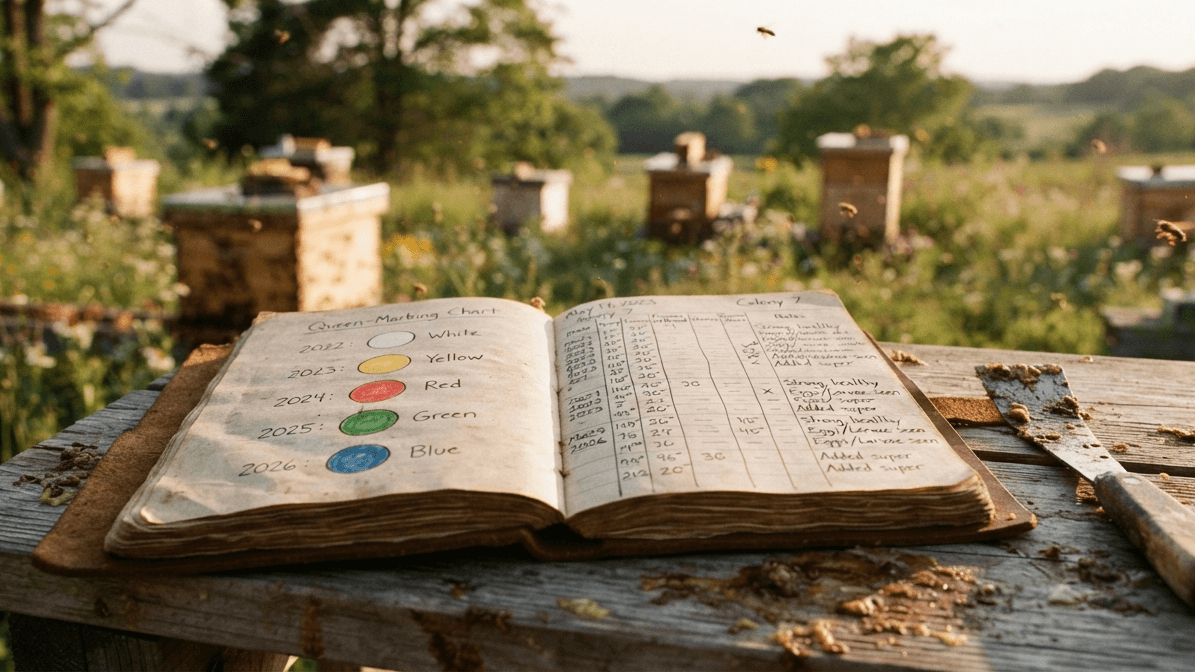
A beekeeping logbook is the difference between managing your bees and guessing about them. You cannot improve what you do not measure: which queen produces the most honey, which apiary overwinters best, when your local flow really starts. After two or three seasons, a good record turns "I think" into "I know." Whether you keep it as a paper beehive log book, a spreadsheet, or an app, the value is in writing it down consistently — and reviewing it.
This guide covers two records every beekeeper benefits from: the inspection logbook (what you saw, every visit) and the queen calendar (the timeline that makes queen rearing and tracking work).
What to Record in Your Beehive Log Book
The best logbook is the one you'll actually fill in, so keep it fast. For each inspection, capture:
| Field | Why it matters |
|---|---|
| Date & hive ID | Ties every observation to a specific colony over time |
| Queen seen / eggs / brood pattern | The single best health signal — eggs mean a laying queen within 3 days |
| Stores (honey & pollen) | Drives feeding decisions, especially heading into winter |
| Temperament | Flags a colony that needs requeening |
| Space / supers | Prevents swarming and tells you when to add room |
| Pests & disease (Varroa counts) | The data behind your treatment timing |
| Actions taken | Fed, treated, added super, requeened — so next visit has context |
The trap with paper beekeeping notebooks and spreadsheets is that they're hard to use later — flipping through a notebook to compare a queen's performance across two seasons is tedious, so most people never do it. That's the whole reason digital hive management tools exist: the same records, but searchable and tied to each hive's timeline.
What a Queen Calendar Is
Keep Your Hive Records in One Place
A free beehive log book and queen calendar that lives on your phone — works offline at the apiary.
A queen calendar (or queen rearing calendar) is a timeline tool built around one fixed biological fact: a queen develops from egg to emergence in 16 days, and a few key milestones fall on predictable days. If you're raising queens, the calendar tells you exactly when to graft, when cells are capped, when to move them, and when virgins emerge — so you're never guessing.
The core queen-development timeline:
| Day | Stage |
|---|---|
| Day 0 | Egg laid (or grafted larva) |
| Day 3 | Egg hatches into larva |
| Day 8–9 | Queen cell capped |
| Day 16 | Virgin queen emerges |
| Day ~21–24 | Mating flights (weather permitting) |
| Day ~25+ | Queen begins laying |
A queen rearing calendar (sometimes shown as a "queen breeding calendar wheel") just counts these forward from your graft date so the work lands on the right day. Even if you're not rearing queens, a simpler queen calendar is useful for tracking each colony's queen: when she was introduced, her age, her laying pattern, and when she might need replacing. Queens are usually most productive in their first two years, so knowing each queen's age is a real management lever — our queen tracking guide goes deeper on managing lineage and performance across seasons.
Paper vs. App: Which Logbook Should You Use?
Both work; they fail in different ways.
- Paper beehive log book / notebook. Cheap, no battery, works anywhere. But it's slow to search, easy to lose, and nearly impossible to analyze across seasons. Fine for one or two hives.
- Spreadsheet. Searchable and analyzable, but awkward in the field (you log at home from memory, and memory is the enemy of good records).
- App. Logs in the moment, ties everything to each hive, and surfaces trends automatically. The catch is reliability in the field — which is why an offline-first app that works with no signal matters for beekeeping records specifically.
The honest answer: if you have one or two hives and enjoy a notebook, keep it. As soon as you're comparing queens, scaling past a handful of colonies, or tired of reconstructing notes from memory, a digital logbook earns its place.
How to Start Keeping Beekeeping Records
- Pick one format and commit — paper notebook, spreadsheet, or app. Consistency beats the perfect tool.
- Log the fast fields every visit — date, hive ID, queen/eggs/brood, stores, and any action taken. Thirty seconds beats a blank page.
- Give every hive a permanent ID so observations accumulate per colony, not in one undifferentiated pile.
- Track each queen's age and source — this is the highest-value single record over multiple seasons.
- Review before each season — read last year's notes to plan this year's flow, treatments, and requeening.
The Bottom Line
A beekeeping logbook and a queen calendar are the two records that quietly make you a better beekeeper: the logbook turns scattered observations into a per-hive history, and the queen calendar puts queen rearing and tracking on a predictable timeline. Start simple, log fast, give every hive an ID, and the data will tell you — within a couple of seasons — exactly which queens and practices are worth keeping.
Keep Your Hive Records in One Place
A free beehive log book and queen calendar that lives on your phone — works offline at the apiary.
Free for up to 15 hives. No credit card required.
Use HiveSense for this
Queen Tracking App — Lineage & Performance
Track every queen in your apiary offline — marking color, lineage, laying performance, and supersedure history.
Offline Beekeeping App — Works Without Internet
Log inspections, voice notes, and BLE sensor data with zero cell signal. Every feature works at the hive.
More from the blog
View allOffline Beekeeping: How to Manage Hives Without Cell Signal
Why remote apiaries have no signal, how beekeepers really keep records in the field, and why offline-first software matters for serious hive management.
How to Harvest Honey: First Year Step-by-Step (2026 Guide)
A complete step-by-step guide to harvesting honey for the first time. When to harvest, equipment options, the day-of process, bottling, labelling, and how much to leave for the bees.